

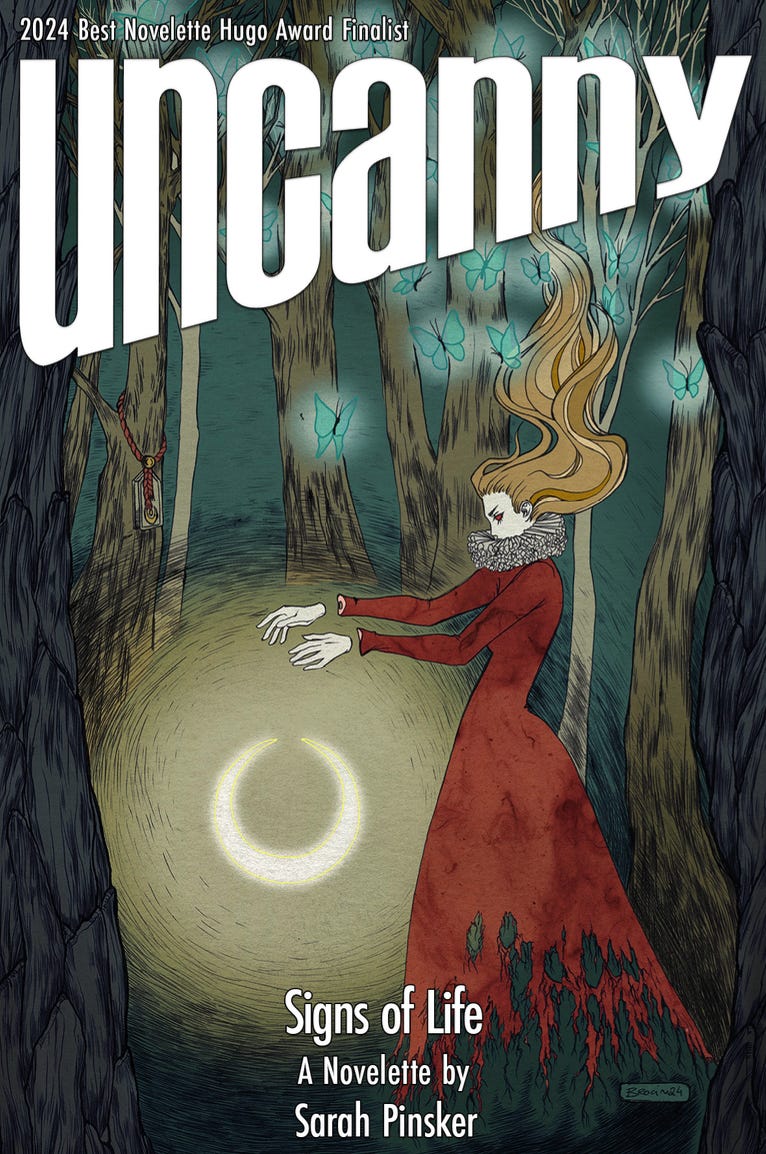
Signs of Life
Sarah Pinsker
Witchcraft is not, apparently, something one does on ones own. Even in Macbeth we start with three Wyrd Sisters. And all the more modern fictional witches (not to mention Wiccans) seem to function in organized groups. In fact, fictional witches almost always learn their craft working at the feet of older witches, like apprentice blacksmiths or Biochemistry PhD students.
One therefore wonders how witchcraft got started. Was there a first witch? Did she discover it for herself? That is how I interpret Sarah Pinsker's Signs of Life. Not as the first witch, but as a de novo discovery of witchcraft, separate from any tradition. I don't know if Pinsker would approve. Neither the word "witch" or any derivative of it appears in the story.
There is one other story like this that I can think of, and it is, appropriately, the oldest witch story I know: the classical Greek witch Circe. Circe was a daughter of gods. The witch in Signs of Life is modern, of undistinguished lineage, and therefore all the more remarkable.
Signs of Life is a finalist for the 2025 Best Novelette Hugo Award, and will get my vote. Here are the finalists, with my ratings.
★★★★☆ “The Brotherhood of Montague St. Video” by Thomas Ha
★★★☆☆ “By Salt, By Sea, By Light of Stars” by Premee Mohamed
★★★☆☆ “The Four Sisters Overlooking the Sea” by Naomi Kritzer
★★★☆☆ “Lake of Souls: The Collected Short Fiction” by Ann Leckie
★★★☆☆ “Loneliness Universe” by Eugenia Triantafyllou
★★★★★ “Signs of Life” by Sarah Pinsker
I have read them all, although I haven't yet written reviews for all. Signs of Life surprised me.