

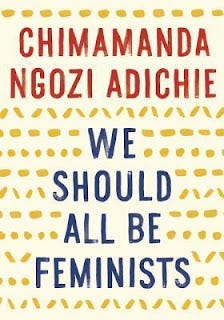
We Should All Be Feminists
Chimamanda Ngozi Adichie
Definitions
We Should All Be Feminists is an essay by Chimamanda Ngozi Adichie based on a TED talk. (TED talks make my brain itch, and then I have to think about sandpaper to scratch, so I haven't watched this one.) It does, I think two main things.
Most prominently, it tells a bunch of stories intended to bring home the point that men and women are treated differently, and that the main thrust of the difference is to treat women as lesser beings than men, beings who should be subordinated. All this struck me as very obvious. I think almost everyone agrees that it is true -- the difference between feminists and nonfeminists is that the nonfeminists think it is a good thing -- that women should indeed be subordinated to men, at least in politics and business and essentially any sphere in which public power is exercised.
The second question Adichie addresses is "What is a feminist?". It is this, really, that the title points to. Different people have very different ideas about what "feminist" means. Adichie begins by describing a bunch of negative stereotypes about feminists. For instance, the first that she mentions is "feminists are women who are unhappy because they cannot find husbands." She lists a bunch of these negative stereotypes, which of course she rejects.
She ends the essay with two definitions of "feminist". The first, which she found in the dictionary, is "a person who believes in the social, political, and economic equality of the sexes." She ends with her own definition, "a feminist is a man or a woman who says, yes, there’s a problem with gender as it is today and we must fix it, we must do better." This definition is, in my opinion, too broad. It includes even those (e.g. the book-banners of Moms for Liberty) who agree that there is a problem with gender today, but think that the problem is caused by the feminists.
Her dictionary definition is less broad than her personal definition. It is probably still too broad for many feminists. My impression is that many feminists regard the statement "I am a feminist" as a kind of membership application, which they will accept only if the person making it meets certain requirements that, depending on the specific feminist evaluating the application, may be more or less strict. Indeed, if you look at the negative reviews of We Should All Be Feminists, you will find folks who don't think Adichie qualifies as a feminist, or don't approve of her variety of feminism.
It seems clear to me that defining "feminist" is a more fraught question than Adichie acknowledges. Between antifeminists who believe that "feminist" means a lot of bad things (Adichie's main target) and exclusionary feminists who are not willing to accept every believer in gender equality into their movement, the question is still unsettled.