
★★★★★ Darwin's Dangerous Idea: Evolution and the Meanings of Life, by Daniel C Dennett
The Evolution of Purpose

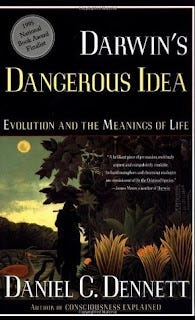
Darwin's Dangerous Idea: Evolution and the Meanings of Life
Daniel C Dennett
The Evolution of Purpose
I read Darwin's Dangerous Idea ten years ago (26-Oct-2012). At the time I was a professor of Biophysics, and I read mainly for the perspective on Biology. However, there is no avoiding the religious implications.
Many of the arguments for belief in religion are of the "god of the gaps" form -- "Here's this thing that no one understands. I propose to explain it by saying that God did it." For instance, historically one of the most persuasive arguments for the existence of a god was the Argument from Design: we look at living things and we see that their organs and they themselves appear to be designed to do certain useful things. For instance, eyes appear to be designed to produce images, and lungs for breathing. Before Darwin (and Wallace), we had no explanation for how this could have come to be (that's the gap), so we proposed that these things were designed by a god.
Now, there are two things to be said about this argument. The first, which has nothing to do with evolution, is that it is in itself extraordinarily weak. Leaping from "I don't know." directly to "This other thing that someone told me HAS to be the explanation!" is obviously not careful thinking. It is, rather, what Dennett calls Philosopher's Syndrome, "mistaking a failure of the imagination for an insight into necessity". The universe is not limited to things you can imagine.
However, people who want to believe find this weak argument extraordinarily tempting. The second thing is that Darwin's Dangerous Idea -- evolution by natural selection, plugged this specific gap in a way that doesn't require one to believe in a thinking, personal designer. Thus, even though the idea of evolution is not necessary to refute the Argument from Design, it makes it clear that in fact there is another possible explanation and thus makes the refutation more convincing. This is not to say that it is impossible to combine a belief in religion with a belief in evolution -- many people do, including some working biologists. However, that some people feel that there is a tension between religion and evolution is shown by the way that some religious authorities have fought against the very idea of evolution, and still do to this day.
As a biologist, I was more interested in Darwin's Dangerous Idea because of how it helped me to think about purpose. Throughout my education as a scientist (even going back to high school) I have been taught to be wary of teleology -- i.e., of ascribing purposes to things. But this wariness is not really compatible with being a working biologist. Everyone can see that the purpose of eyes is seeing, the purpose of lungs is breathing (among other things, such as speaking), and the purpose of mitochondrial F1 ATPase is synthesizing ATP. We try to talk around it, by using words other than "purpose", but this is silliness.
Dennett discusses how evolution gives biological objects purposes. (He has an excellent YouTube lecture called "The Evolution of Purpose" on this subject.) I find Dennett's careful discussion of these ideas helpful in thinking about how living things work.