
★★★★☆ The Hanging Tree, by Ben Aaronovitch, Kobna Holdbrook-Smith (narrator)
Family sagas

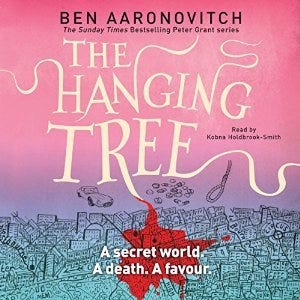
The Hanging Tree
Ben Aaronovitch, Kobna Holdbrook-Smith (narrator)
** spoiler alert **
Family sagas
I read Ben Aaronovitch's The Hanging Tree for the first time about a year ago, on kindle -- my review here. Since then I have read every currently extant work in the Rivers of London series. At the date of writing this review that includes novels through Amongst Our Weapons and novellas through Winter's Gifts. Wanting good audiobooks to listen to while walking or driving, I have been working my way through the series in audio format. The experience is different from the first read, because it's an audiobook (duh...) but also because I know how everything is going to work out, and I know what these characters will become to Peter. There will be spoilers, not only for this novel, but for the series as a whole. You have been warned!
What struck me right from the start on this re-read was that this novel is about families. It begins when Lady Tyburn calls in the favor Peter has been owing her. Lady Ty's teenage daughter Olivia was at a party where a young woman died from tainted drugs. Lady Ty wants Peter to ensure that Olivia is held harmless. Thus the family theme is there from the start. And it keeps recurring. Peter's father's teeth have been repaired thanks to money collected through a Kickstarter campaign, and also contributed by Peter. Peter's father, a jazz trumpeter, has been unable to play for years because his bad teeth ruined his embouchure.
I’d been there when he’d tested his new embouchure, watched him as he lifted his trumpet to his lips, paused to nervously wet them with his tongue and then blow a single pure note. I’d watched him stop and stare at his trumpet in disbelief and then at my mum who’d pinched the bridge of her nose to hide her tears. Then he smiled at me and for that moment, and just that moment, I forgave him everything—everything—because now I knew what joy looked like and I was part of it.
Peter's relationship with Beverly Brook, and the possibility of them making a family, is also prominent. Peter's mother corners him and embarrasses him by telling him in no uncertain terms that she wants Peter and Bev to get to work giving her grandchildren. Later Lady Ty tells Peter that a long-term relationship between him and Bev will not work, as he will get old and die, and she will not. In future books Peter will, in true Peter Grant fashion, plunge into the abyss, marrying Bev and getting twin demigoddess daughters. We also find out at last who the Faceless Man is. It turns out that the girl who died of bad drugs was his daughter, and he is sufficiently distraught to make serious mistakes in his anger, which lead to his identification.
Kobna Holdbrook-Smith is for the most part the excellent narrator we have become used to. I was particularly impressed with his portrayal of Albert Pryce (the father of one of the other party girls). Pryce is obviously a nasty character, but Kobna's portrayal made it clear how viscerally awful he is -- a slimy, oily creep who made my skin crawl.
Unfortunately, this novel also pokes at Kobna's Achilles heel -- American accents. He does, I will give him credit, manage to produce two distinguishable American accents. One, from an American wizard Dean Miller, is described by Aaronovitch thus: "His accent was Southern-ish but not the caricature I’d heard on TV—it was the deliberately cultured accent of someone working hard to convince you they were a reasonable and civilized man." Kobna does a creditable job of producing an accent like that.
The other is our old friend Kim Reynolds. Kobna's Kim sounds like a California high-school girl. Now, let's take a moment to marvel that Kobna is capable of producing speech that is instantly identifiable as that of a perky teenage girl, while also marveling at how inappropriate this accent is for Kim. Kim grew up in Oklahoma and is now an FBI agent. It is possible that Kobna doesn't know of Kim's origins, though Aaronovitch has figured it out -- he has Kim wearing "an orange and gray sweatshirt with OSU embossed across the front." The colors confirm that that is an Oklahoma State University sweatshirt. But perhaps he didn't tell Kobna. To be sure, Aaronovitch's grasp of American idiom is also shaky, as shown by this bit of dialog
“And you want me to persuade Nightingale,” I said.
“Would you?” said Kimberley. “Because that would be swell.”
That usage of "swell" was current in the 1930s and 1940s, but hasn't been used unironically in my lifetime. I suppose I should be thankful that Aaronovitch doesn't have Kim say, “Because that would be groovy.”
Well, I'm nit-picking. If you don't care about the authenticity of American accents, or even if you do, Kobna does a great job where it counts. And the story moves the Rivers of London plot forward a lot.