

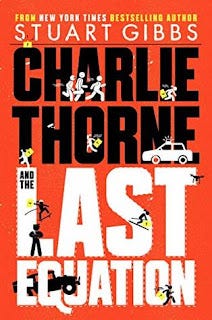
Charlie Thorne and the Last Equation
Stuart Gibbs
Charlotte (Charlie) Thorne is a math and physics genius. She is also a 12-year-old girl. Also, somewhat debatably, a thief. In Charlie Thorne and the Last Equation it falls to her to decipher clues left by Albert Einstein to find something called the Pandora equation, which can do either great good or great harm.
Charlie Thorne and the Last Equation was not what I expected. My previous experience with Stuart Gibbs is his Spy School series. The Spy School books are farces that mock the absurdity of James Bond movies, and at their best they are very funny. Since in Charlie Thorne and the Last Equation, Charlie spends most of her time working with or against spies, I thought I knew what was coming. However, in The Last Equation, Gibbs takes spies seriously. In the Spy School books the spies are incompetent buffoons -- here they are formidable. Their opponents are also truly to be feared. Charlie and her fellow spies are up against white supremacists whose goal is nuclear devastation of "inferior races". Heavy stuff!
The most appealing thing about Charlie is that, although she is a genius, she is also a twelve-year-old girl. To tease her brother, she sings "Dante and Milana sitting in a tree, K-I-S-S-I-N-G." She loses fights. For me, perhaps the hardest-hitting moment of the book was this little dialog between Charlie and CIA agent Milana Moon,
Charlie: I'm only a twelve-year-old girl...
Milana: Don’t talk like that.
Charlie: What? You don’t like my attitude?
Milana: I don’t like you saying ‘girl’ like it’s a character flaw.
This is not a big moment in the book. Gibbs doesn't emphasize it or come back to it in any way. And I suspect it won't hit most readers the way it did me -- most will probably read right past it.
The problem with Charlie Thorne and the Last Equation is that Gibbs never seems to have figured out quite what book he wanted to write. In the Acknowledgments he says that he initially conceived it as an adult book. Ten years later, after he had become a successful children's author, he came back to it with the idea that it could be a kids' book. He worked hard at authenticity, spending time in Jerusalem and the Mt Wilson Observatory and studying up on Einstein's life. But then he undermines all that work by making his heroine a math and physics genius, even though it would be flattery to call Gibbs's knowledge of these subjects rudimentary. He mentions also that his wife, who helped him to write an authentic girl character, died while the book was being written, which would (to say the least) throw anyone off.
I intend to go on to read Book 2, Charlie Thorne and the Lost City, in the hope that Gibbs figured out by the time he wrote it what book he wanted to write.