

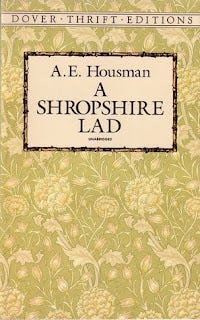
A Shropshire Lad
AE Housman
For a breathe I tarry...
It is my habit to read a page or two of poetry every morning. I find that I can't read a book of poetry as I would a novel, one page after another, all day long. I need some time to take it in. Even at this pace, one can, if one persists, get through a lot of the canon of classic poetry. I chose A.E. Housman's A Shropshire Lad because of its role in Roger Zelazny's story For a Breath I Tarry. For a Breath I Tarry is a science fiction story set after humanity has accomplished its own self-extinction. A sentient machine, Frost, wishes to understand humans. To aid in this purpose, he reads books, the first three being Human Physiology, An Outline of History, and A Shropshire Lad.
A Shropshire Lad is the Platonic ideal of the "thin volume of poetry" you have heard of so often. It is, in this Dover Thrift edition, 51 pages, including notes and index. It contains 63 poems. A few have titles, but most are just numbered. The Shropshire of the poems is imaginary. Housman was not from Shropshire, nor was he a "lad" when he wrote the poems, being by then a 36-year-old professor. The poems do not tell a coherent story, at least not one that I could discern, but they do tell stories, and there is a central character, the young man Terence. He is, at the start of the book, twenty years old. We know this, because he tells us (poem II)
Now, of my threescore years and ten,
Twenty will not come again,
And take from seventy springs a score,
It only leaves me fifty more.
This concern with the transience of life pervades the poems. Many of them do more than hint at death: murder, suicide, and death in battle are among the stories told. One of the poems (XIX) is entitled "To An Athlete Dying Young", and is more congratulatory than mournful.
This focus on death inspired some parodies. Indeed, in poem LXII ( the second to last), Housman mocks himself
But oh, good Lord, the verse you make,
It gives a chap the belly-ache.
The cow, the old cow, she is dead;
It sleeps well, the horned head:
We poor lads, ‘tis our turn now
To hear such tunes as killed the cow.
Housman was an atheist, and, unusually for the time and place when they were written, especially given the focus on mortality, religion is virtually absent from the collection. The first poem, "1887", does indeed mention God, but more in mockery than in reverence. There is even a poem (XLIII) entitled "The Immortal Part", but it transpires that the immortal part referred to is not the soul, but the bones.
My favorite poems are those that are less explicitly about death, but rather focus on the transience of life. I will end with XXXII, which inspired the title of Zelazny's story
From far, from eve and morning
And yon twelve-winded sky,
The stuff of life to knit me
Blew hither: here am I.
Now—for a breath I tarry
Nor yet disperse apart—
Take my hand quick and tell me,
What have you in your heart.
Speak now, and I will answer;
How shall I help you, say;
Ere to the wind’s twelve quarters
I take my endless way.