

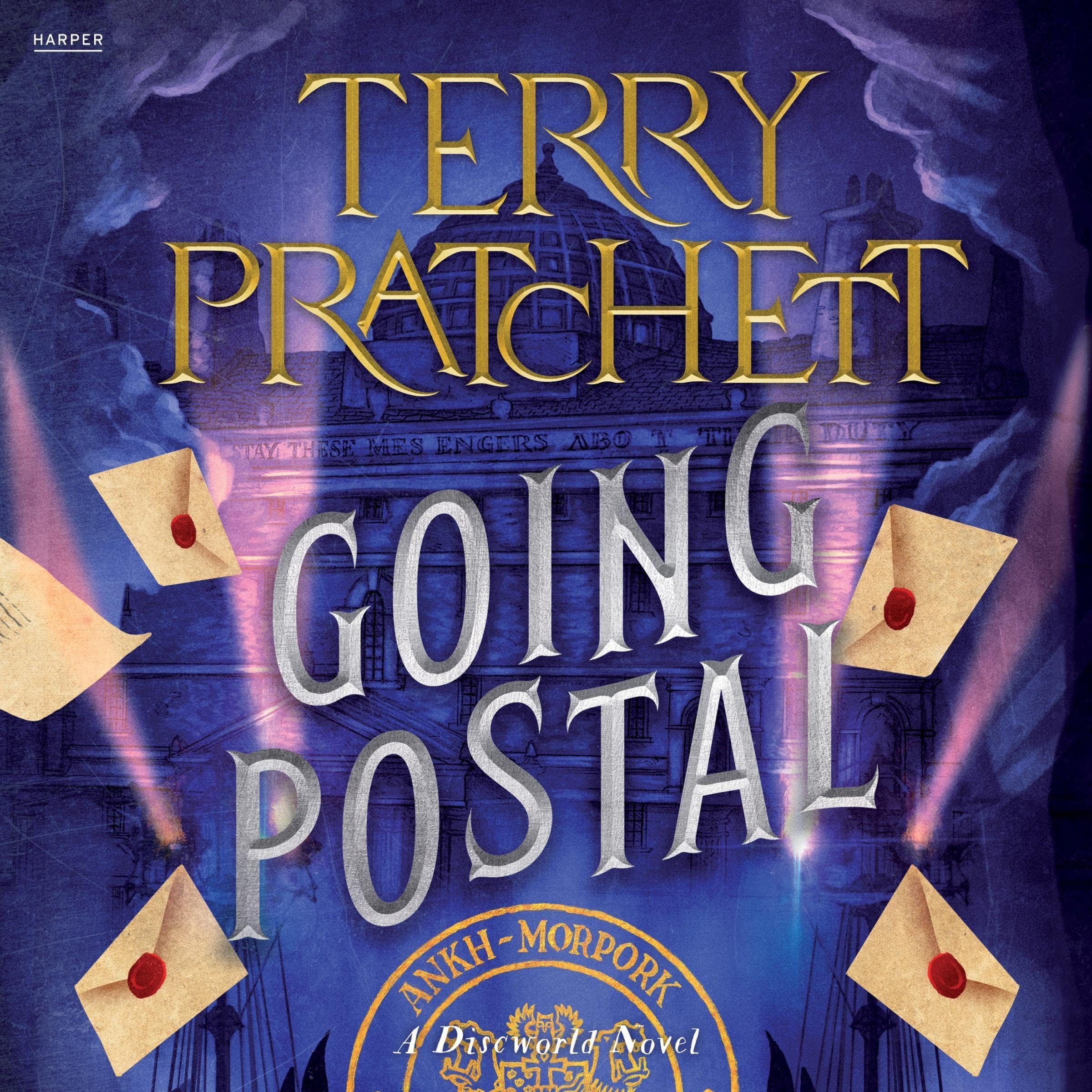
Going Postal
Terry Pratchett
Pratchett does Orwell and Hiaassen
I'm doing something unfair. I'm giving Going Postal a lackluster 3-star rating, even though if I had just picked it up out of nowhere, it would certainly have rated four at least. Why? Because it is not what I expect of novel 33 in Terry Pratchett's Discworld series. As far as I'm concerned Pratchett has set expectations, and I'm knocking off stars if he fails to meet them. Usually when I listen to a Discworld novel I feel, "No one but Pratchett could have written this." I don't feel that way about Going Postal. It's a very good novel that could have been written by George Orwell or Carl Hiaasen. For most authors that would be high praise. For Sir Terry it is not.
Going Postal is, as already mentioned, the 33rd full-length novel in the Discworld series. It is also the fourth in the Industrial Revolution subseries, and the first in the Moist von Lipwig subseries, which is a strict subset of the Industrial Revolution subseries.
For several Discworld novels we've been hearing about the Clacks -- a series of semi-automated semaphore towers that allow relatively rapld signaling across the Discworld. For instance, a Clacks message from Ankh-Morpork to Genua might take a day -- a coach would take a month. The Clacks is to the Discworld roughly what the telegraph was to ours. The Clacks more or less defines the Industrial Revolution subseries.
The Clacks was the invention of Techies. (Not a Discworld term, but the type is recognizable even across universes.) As Going Postal begins we recognize something familiar: it is has been captured by corporate actors whose goal is to extract as much money from it as they can, with no regard for keeping it functional. OK, that too is recognizable across universes.
Ankh Morpork has a Post Office. It hasn't been a functional concern for many, many years. But Lord Havelock Vetinari has decided for reasons of his own to bring it back from the dead. If it occurs to you that the Post Office competes with the Clacks, and that this fact would be unlikely to escape Lord Vetinari's attention -- Congratulations! Give yourself a cookie. Vetinari chooses Moist von Lipwig to revive the Post Office. You probably think you don't know von Lipwig, but in this you are almost certainly mistaken. Moist is a standard-issue Picaresque, and you have met him in a hundred other books.
Thus, we have a very familiar-seeming novel with familiar characters. Now, of course, Pratchett does a great job with it. His Orwellian language is more Orwellian than Orwell himself. His corrupt Hiaassenian officials are as Hiaasenian as Hiaasen himself could write them. And of course we have Discworld stalwarts as Havelock Vetinari and Sam Vimes.
So, it's good. Of course it's good! Yet it also manages to disappoint.