

Hypnogogia
Allen woke to the sound of a fierce snarl. It sounded like a dog, a large one. He was in bed, his face turned to the right. The sound had come from behind him. Allen lived alone. He did not have a dog.
He didn’t turn to look. He knew it wasn’t real. He didn’t want to see the hellhound. If you saw the hellhound, that made it real. And then you died. That, after all, was what hellhounds were for. He shut his eyes, relaxed, and went back to sleep.
It happened again the next night. This time, instead of a dog’s snarl, he heard someone speak his name, “Allen.” He recognized the voice—it was one of his colleagues from work, Constance. Her light Chinese accent was unmistakable.
Allen was a little freaked out by the hallucinations. For the next few weeks, Allen tried to get plenty of sleep, keep regular bedtimes, and avoid caffeine late in the day. It seemed to work. For three weeks no mystery sounds interrupted his sleep. Then, on the twenty-second night, he saw his first visual hallucination. It was a woman’s detached head floating in midair. He recognized it—it was from a music video.
This time he was intrigued. Eventually he found a trick to stay near sleep. He lay on his back. In his right hand he held a wooden ruler. He held it loosely with one end resting on the mattress, so that the ruler stood up vertically. He closed his eyes and allowed his thoughts to drift, as if to fall asleep. When he began to doze, his hand loosened, the ruler fell, waking him. It was simple, and it worked. In this way he could drift into sleep over and over for an hour.
It worked the first time he tried it. The floating head appeared again—the very same one—and this time it spoke his name, “Allen,” in the voice of Constance-from work. Why Constance? Constance was not a close friend. But his hypnogogic brain had decided to use her voice, twice now.
He continued each night. Sometimes now he would drift into a kind of waking dream, where sounds and images appeared and moved before his eyes, even while he still felt himself to be awake. There were all sorts of visions, but the floating head was a frequent visitor. When it spoke, it was always in Constance’s voice.
The hellhound returned. He heard the snarl again. Algain it was behind him. He tried to turn to look at it, but he couldn’t move. He couldn’t turn his head or move a muscle. His body was as relaxed as a rag doll, and as incapable as a rag doll of voluntary movement. His mind was not relaxed. This paralysis was scary, especially when a dog had just snarled at him from behind. But the snarl was not repeated. He was soon fully asleep, and when he woke, he could move normally.
#
He lay down one night in a kind of frenzy of thought. He had been working on a proof all day. He needed three lemmas. He had two of them, not written down, but clear in his mind. He knew that there was a route to the third, because he had seen it proved once. But he couldn’t remember how it was done. He didn’t need the ruler trick that night—he knew he would not sleep until he got it. Vector spaces and dimensions swam before his mind. They were not exactly images, because they were not pictures. They were structures made of pure thought. Then the head appeared. Constance’s voice said, ”Like this.” The ideas arranged themselves. Allen understood that somehow, even without hands or arms, the head was arranging them. Soon the ideas were lined up in his mind, each leading clearly to the next, and he knew he had the third lemma. He lay awake another hour constructing the full proof. Then he fell asleep. When he got up the next morning, it was all there. He sat down at his computer and typed it up.
The next night, the head appeared again. Constance’s voice said, “I’m leaving.” He tried to ask it, “Where? When?” But that never worked. He had no voice, and the head never answered his questions.
The next day he learned that Constance had left for a trip to China. She would be gone for a month.
For a month the head did not appear in his visions. He didn’t understand that. This was all in his mind—why did it matter if Constance went to China? The dog did come. It snarled at him almost every night, from somewhere he could not see. Paralysis frequently accompanied it.
#
At work one day Allen joined in a discussion of the Nobel prizes. It was the beginning of October, and the year’s prizes would soon be announced. As always, everyone knew which discoveries were likely, eventually, to be celebrated. Which ones would come up this year, and which specific scientists would be awarded the prizes, were anyone’s guess.
That night, the head appeared to Allen again, and Constance’s voice said some names, “Rothman, Schekman, Südhof, Karplus, Levitt, Warshel, Englert, Higgs.” Allen recognized the first three. They were molecular biologists who had figured out a mechanism used to move molecules within and between cells. The other names were unfamiliar, except for the last. The biggest news in physics the previous year had been the discovery of the Higgs boson—could it be that Higgs?
It was. The science prizes were announced the seventh, eighth, and ninth of October, and the eight names were those that the floating head had recited to Allen.
This was astonishing. It hadn’t surprised Allen that he had figured out a proof in a hypnogogic reverie. After all, constructing proofs was something that he knew he could do. It wasn’t even all that shocking that the head had told him Constance was leaving. He hadn’t thought he had known it, but it was possible that he had heard it mentioned and forgotten. It was plain weird that the voice went away when Constance was away, but everything about the head was weird.
However, there was no plausible way that Allen could have named the Nobel Prize winners, even if he was some kind of subconscious genius. Outside the committees that chose them, no one knew the winners until the announcement.
#
Now he was curious. Could he predict other things? He didn’t know how to ask the head. It never seemed to listen to him or respond. But seemed likely that it named the Nobel Prize winners because Allen had been thinking about that.
Could it predict stock prices? As soon as he had the thought, Allen dismissed it. It seemed far too big an ask. He knew that a person who could predict stock prices could use that information to make lots of money. And if there was one thing that fairy tales and reality agreed on, it was that everything has a cost. Besides, he wasn’t really interested in finance or even in becoming rich.
The next night the head said to him, “Make a wish.” A hundred thoughts raced through his head. He was not interested in wealth, and it seemed plain silly to wish for love. Could he wish to know the true answer to any question? No. If knowing stock prices was too big, then truth and love were huge. He had a thought. He would wish to know of danger. That didn’t seem like a big ask. After all, he could hardly remember a time in his life when he had been in real danger. The thought formed in his mind. He wondered how to communicate it to the head, but the head nodded. The wish had been taken from his mind.
Then came paralysis and the snarl of the hellhound. As always, it was behind him and Allen could not see it. But this time he felt its teeth bite his left ankle. Painfully. That had never happened before. When he woke, the paralysis and the pain were both gone.
It seemed a light price for his wish, if indeed the wish had been granted. He soon learned, though, that the price was not as small as he had supposed. The next day in the cafeteria he got into line just behind Constance. She was wearing a brace on her left ankle.
“What happened to your leg?” he asked her.
“It’s a sprain,” she said. “Happened late last night. I was walking around at home, and I somehow managed to twist my ankle.”
“Ouch! Yikes.”
“Hurt like Hell. But I live above a CVS. This morning I hopped down there and got this brace and some ibuprofen. They help.”
#
A week passed. Allen continued to enjoy his nightly trances, but nothing so uncanny happened again. He dismissed the wish from his mind. It seemed unlikely it had been granted, and even if it had, he might never know. That day, though, there were intense thunderstorms. A siren sounded. Allen knew at once—he didn’t know how he knew, but he knew—that Constance was in trouble. He ran down the stairs to her floor. He met her hobbling along just outside her office.
“Constance! We’ve got to get downstairs. This building is about to be hit by a tornado.”
“What? How do you know?”
“I saw the alert on the web.” This was a lie, but he had to say something. He knew he needed urgently to get her to safety.
The elevators, of course, were halted by the alarm. Slinging Constance’s left arm around his shoulders, Allen supported her to the stairs and helped her down them to the ground floor. There he and others helped her into the basement tornado shelter.
They all spent a couple of hours there. Their building was indeed hit, just as Allen knew it would be. It was loud, and it was terrifying.
When it was all over, Constance said, “Thanks for helping me!”
“Well, it was only fair. I kind of owed you.”
“That doesn’t make any sense.”
“You’re right,” Allen said. “It doesn’t. Can I buy you a cup of coffee?”
“No, you may not. You just saved me. I’m buying.”
Afterword
This story began when I had the experience described in the first paragraph—I was wakened by an auditory hypnogogic hallucination of a dog’s snarl behind me. Shortly after I happened to see the “9Crimes” music video by Damien Rice, and it inserted itself into the story.
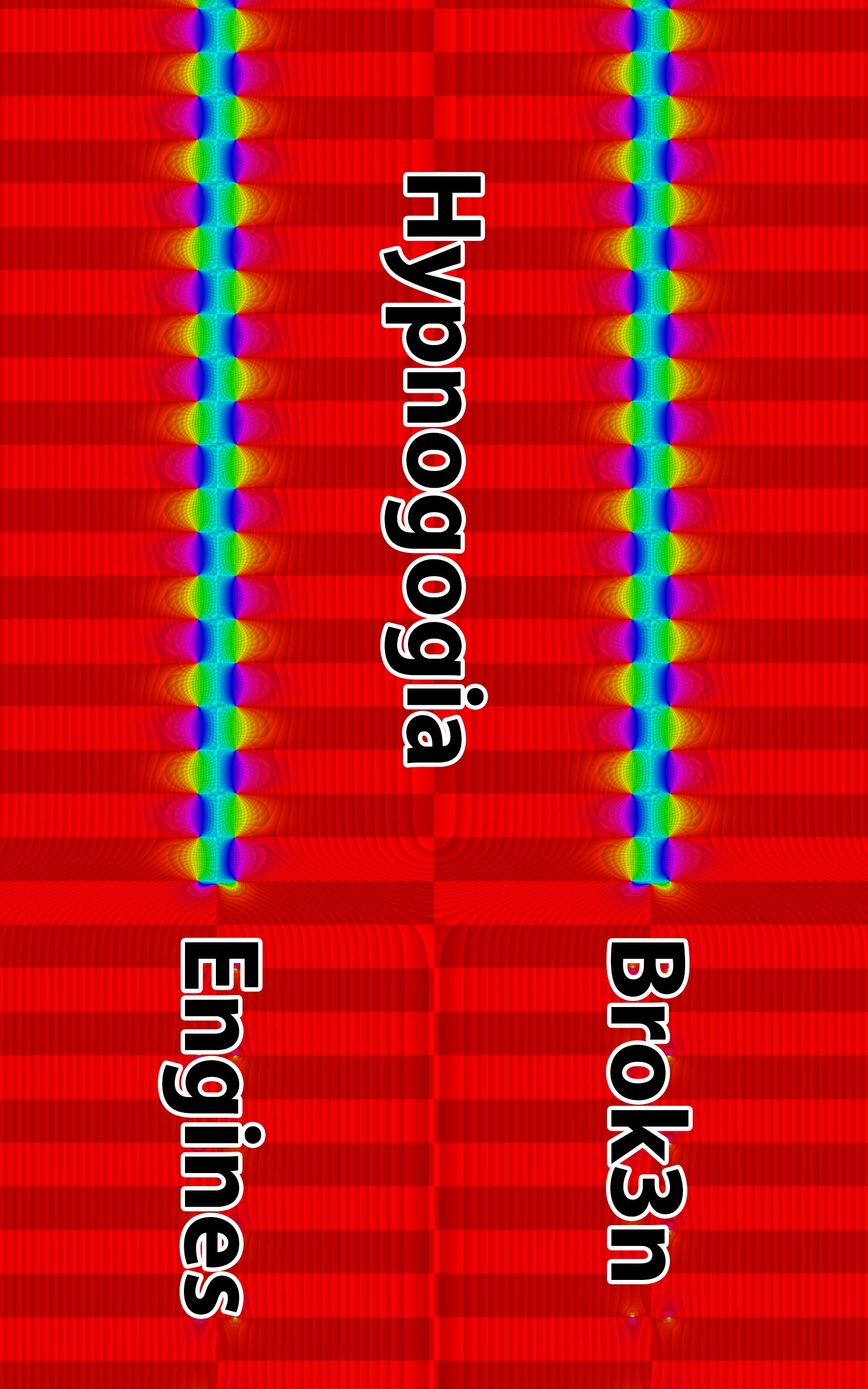
The cover image is a phase portrait of f(z):

A phase portrait is a visualization of a complex function introduced by Elias Wegert in Visual Complex Functions: An Introduction with Phase Portraits.
This is such a unique piece of writing. I once woke up to this mad technical sounding zipping noise in my head and then a short burst of radio chatter. Obviously freaked out I asked my doctor who said it was a form of sleep paralysis. It never happened again but sometimes I wonder if my brain became some sort of receiver for an accidental moment haha
A colleague of mine remarks,
"Do you know the first recorded incidence of REM sleep behavior disorder?
it is in the old testament—when Jacob wrestled with the angel of God in his sleep and broke his hip. In fact, that is the etiology of the name “ISRAEL” (in Hebrew “YISRA” means to wrestle with/fight and “EL” means god; literally translates as He Who Fights with God). after that incident, Jacob was known as “ Israel” and his off spring as “Israelites”)."