

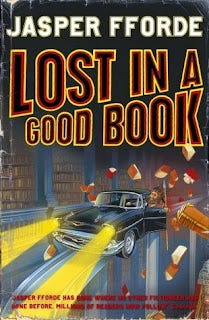
Lost in a Good Book
Jasper Fforde
It’s infrastructure week!
This novel has two problems to solve. One is a problem Thursday has. In The Eyre Affair Thursday killed Acheron Hades (the third most evil person on Earth -- numbers one and two have yet to be revealed to us) (of course we all know that in fantasy and science fiction no one is ever so dead that they can't come back) and trapped Goliath Corp mean person Jack Schitt in a copy of Edgar Allan Poe's The Raven. Goliath Corp wants him back, and has eradicated Thursday's new husband Landen to coerce her to get him out. ("Eradicated" means they rearranged the past in such a way that Landen no longer exists, although Thursday still has memories of him.)
The second problem is a problem Jasper Fforde has. The premise of the Thursday Next series is that people can move from the real world into books, where they become characters. In The Eyre Affair this was accomplished mainly by means of a device, the Prose Portal, invented by Thursday's genius uncle Mycroft. Not wanting it to be exploited by Goliath, Mycroft at the end of The Eyre Affair destroyed the only Prose Portal he had built and retired, apparently vanishing from the face of the Earth. In Lost in a Good Book we learn that Mycroft built himself another Prose Portal and made his way into the Sherlock Holmes stories, where he now appears as Sherlock's genius brother Mycroft.
So, Fforde has now created for himself a little problem. He has eliminated access to the technology for getting people into and out of books. However, even in The Eyre Affair he hinted at another, low-tech way of accomplishing the feat. As a child Thursday, on a visit to Haworth House entered Jane Eyre at the point where Mr Rochester meets Jane. Also, in Jane Eyre she met a Mrs Nakajima from Osaka who made regular tourist excursions to the precincts of Jane Eyre. This low-tech method works just by reading the book. People with the gift can read themselves into a book just by reading its words. They can even take others with them.
It is interesting that Cornelia Funke's Inkheart trilogy, which is based on the same premise, was published at about the same time as the Thursday Next series. (Inkheart: 2003, The Eyre Affair: 2001.) I doubt either author got the idea from the other. To any avid reader the idea that you can read yourself into a book, or can read characters from the book out into The Real World is obvious -- it is what we do all the time. I have visited Martin Arrowsmith in Winnemac and had casual conversations with Laura Ingalls since I was a kid.
Fforde spends much of Lost in a Good Book creating an elaborate infrastructure for migrating into and out of books. Thursday has to learn how to work this magic and the elaborate organization Fforde creates to exploit it. All this at the same time as she is trying to get Landen back. The result, in my opinion, is a novel that is too complicated and unfocused for ordinary readers (by which I mean ME, of course) to keep their eyes on the ball at all times.
But Lost in a Good Book still has all the things I loved in The Eyre Affair -- the literate alternative world, the literary in-jokes (although I'm not sure I understand above 20% of them). So, it is still fun, but not quite as fun as The Eyre Affair. My hope is that, now that Fforde has explicated the magic/technological infrastructure, we will be able to just exploit it in the sequels. Thus, I intend to continue.