

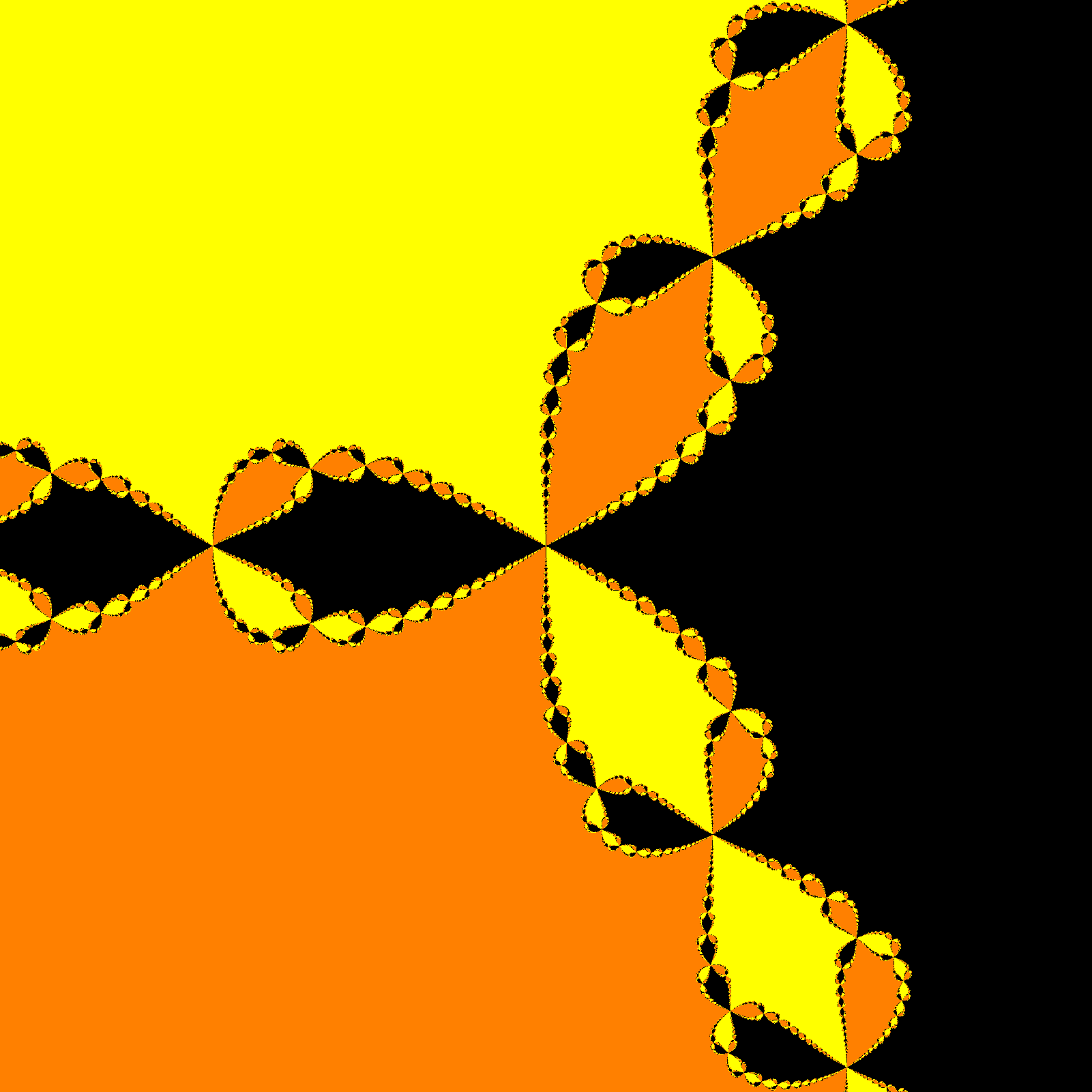
My substack icon
I write this article to celebrate reaching 100 subscribers for the first time. One or two of you have asked, and probably a few more have wondered, what the black, orange, and yellow propeller-like image I use for my substack icon is. I will explain that here. But be warned—there will be math. LOTS of math. Even some math-major math.
Cube roots of 1
The picture above shows what happens when you use a method invented by Isaac Newton and Joseph Raphson to find the numerical value of cube roots of 1. A cube root of 1 is a number z such that
There are exactly three values of z for which that equation is true. They are1
Here i is the square root of -1. That is, i is defined as a number such that,
Numbers like the second and third cube roots of 1 shown above are called complex numbers. A complex number has an imaginary part—this is the part that is multiplied by i, and a real part, the part not multiplied by i. So, for the second cube root, the real part is -1/2 and the imaginary part is √3/2. A number whose real part is 0 is commonly called an imaginary number.
I emphasize that the words “real” and “imaginary” as used in mathematical analysis have nothing to do with the ordinary English meanings of those words. Imaginary numbers are no less real (in the ordinary English sense of the word) than real numbers. The real/imaginary nomenclature is purely historical. We get it from the first people to use imaginary numbers. They were uncomfortable with this new type of number (just as some of you readers are now).
Modern mathematicians (and physicists and engineers) are comfortable with complex numbers. We tend to think of them as points on the complex plane, like this.
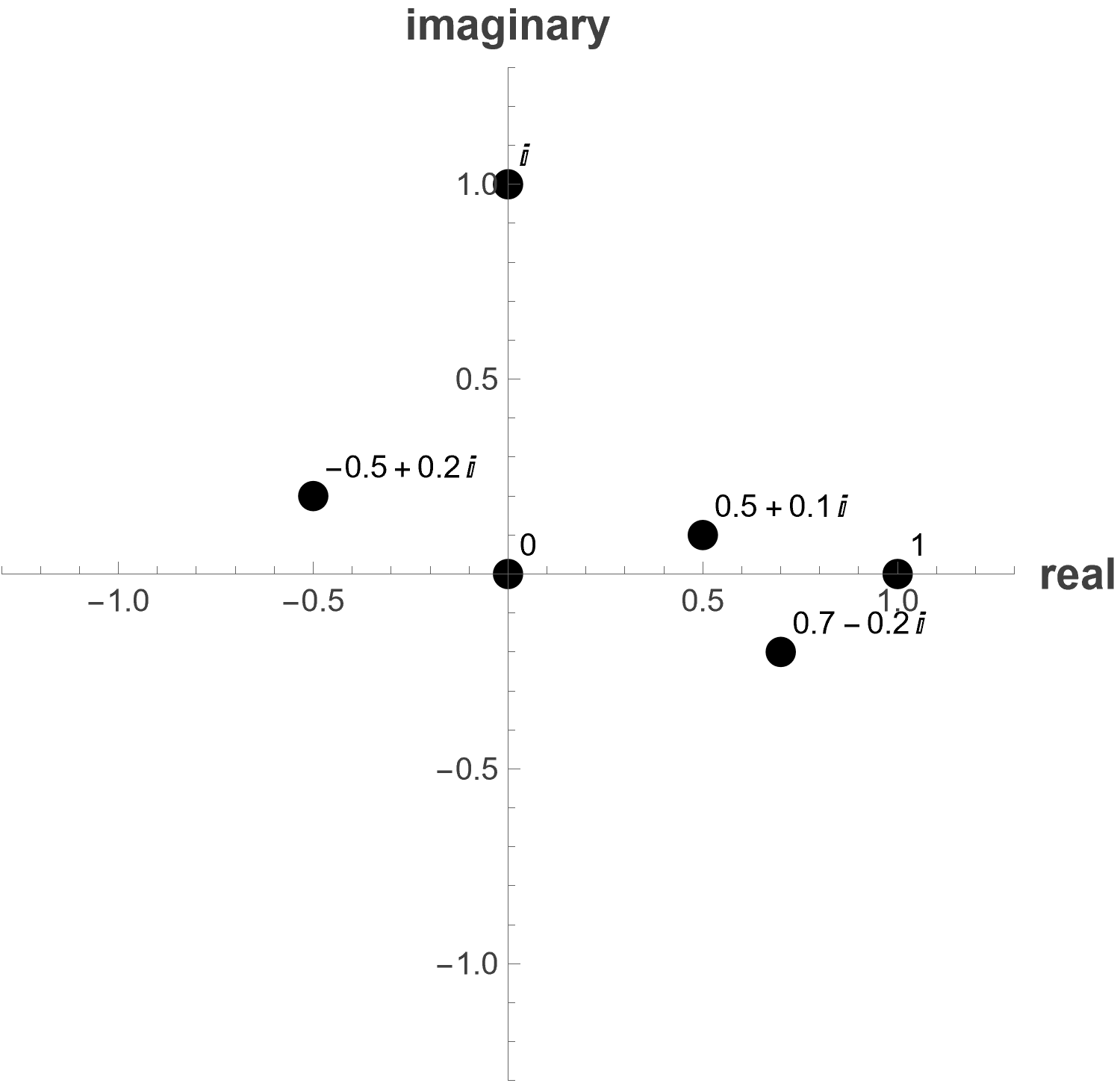
The picture above shows six random complex numbers: -0.5+0.2i, 0, i, 0.5+0.1i, 0.7-0.2i, and 1 on the complex plane. Now I’ll show you the three cube roots of 1 on the same kind of plot.
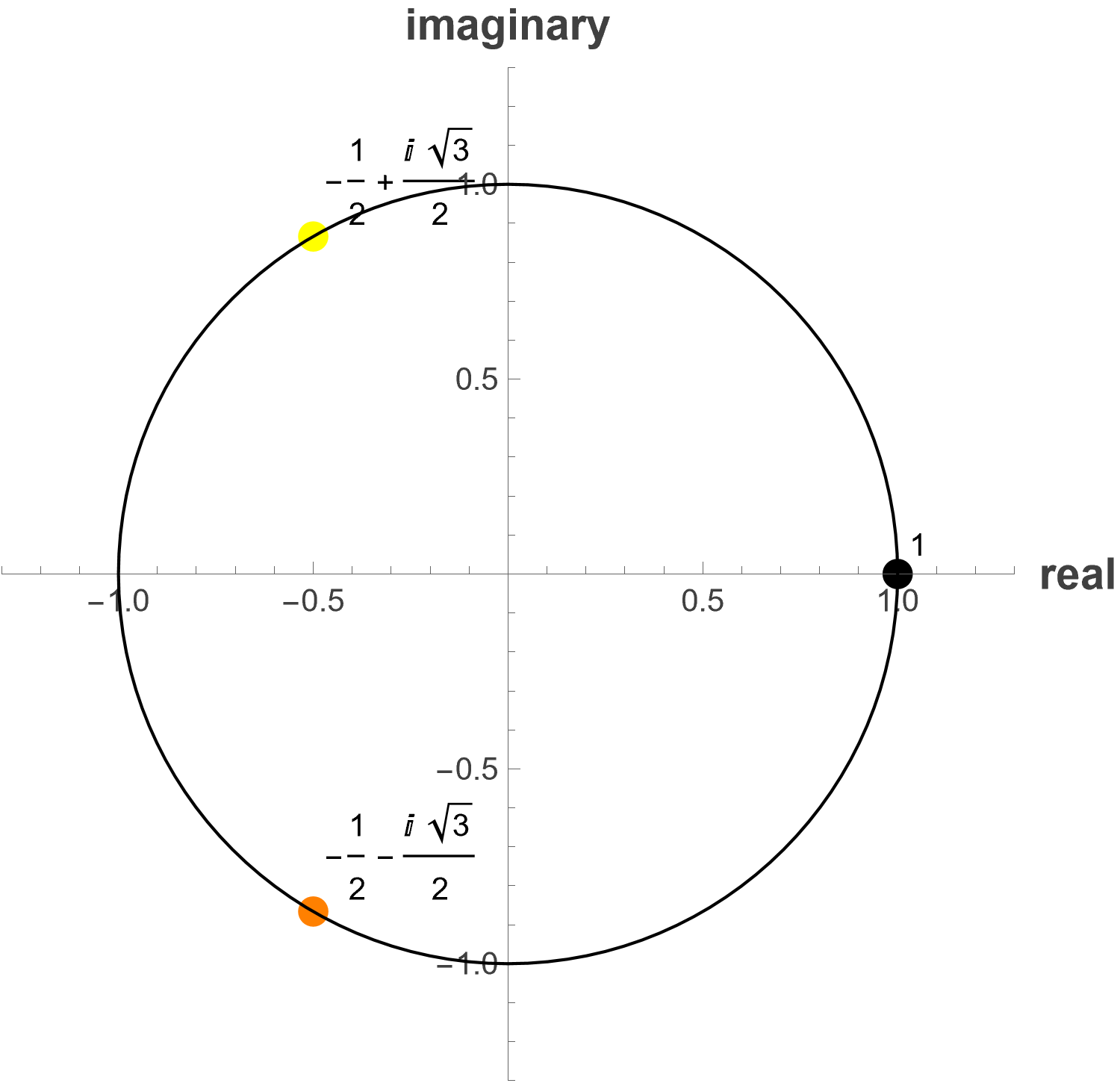
I’ve colored the three roots black, yellow, and orange. I also plotted a circle of radius 1 centered at 0 (the unit circle), so that you can see that all three roots are on the unit circle and are equally spaced.
Newton’s method
You now know what the cube roots of 1 are. To explain my logo, I need to tell you about Newton’s Method. Newton’s Method is an approach to a common problem in mathematics. Most mathematical problems can’t be solved exactly. Newton’s Method helps to find an approximate numerical solution.
Suppose you have some equation in which z is the only variable, and you want to find a value of z that makes the equation true. Newton’s Method is a way of finding a number that comes very close to solving your equation. The first step is to make an “initial guess,” that is, to pick a value of z that is close to a solution. Newton’s Method is a recipe for calculating another value of z that is closer to the solution. It uses calculus, but only very simple calculus—every freshman calculus student learns Newton’s Method. Here’s what it looks like for the equation z³=1.
Now you have a new guess. If everything is working well, you can plug that into the Newton formula again and get a better guess. You keep doing this until you have a good enough numerical value of z for whatever purpose you have in mind. In practice, this works shockingly well if the initial guess is good.
But that’s the problem, of course. How do you come up with an initial guess? How much does it matter?
We don’t need Newton’s Method to find cube roots—that’s a problem that can be solved exactly. But that means we can use it to answer the question about how much initial guesses matter. Let’s try to find a cube root of 1 starting with the guess z=-0.5+0.2i. (I chose that value as a random complex number that isn’t close to any of the cube roots of 1.)
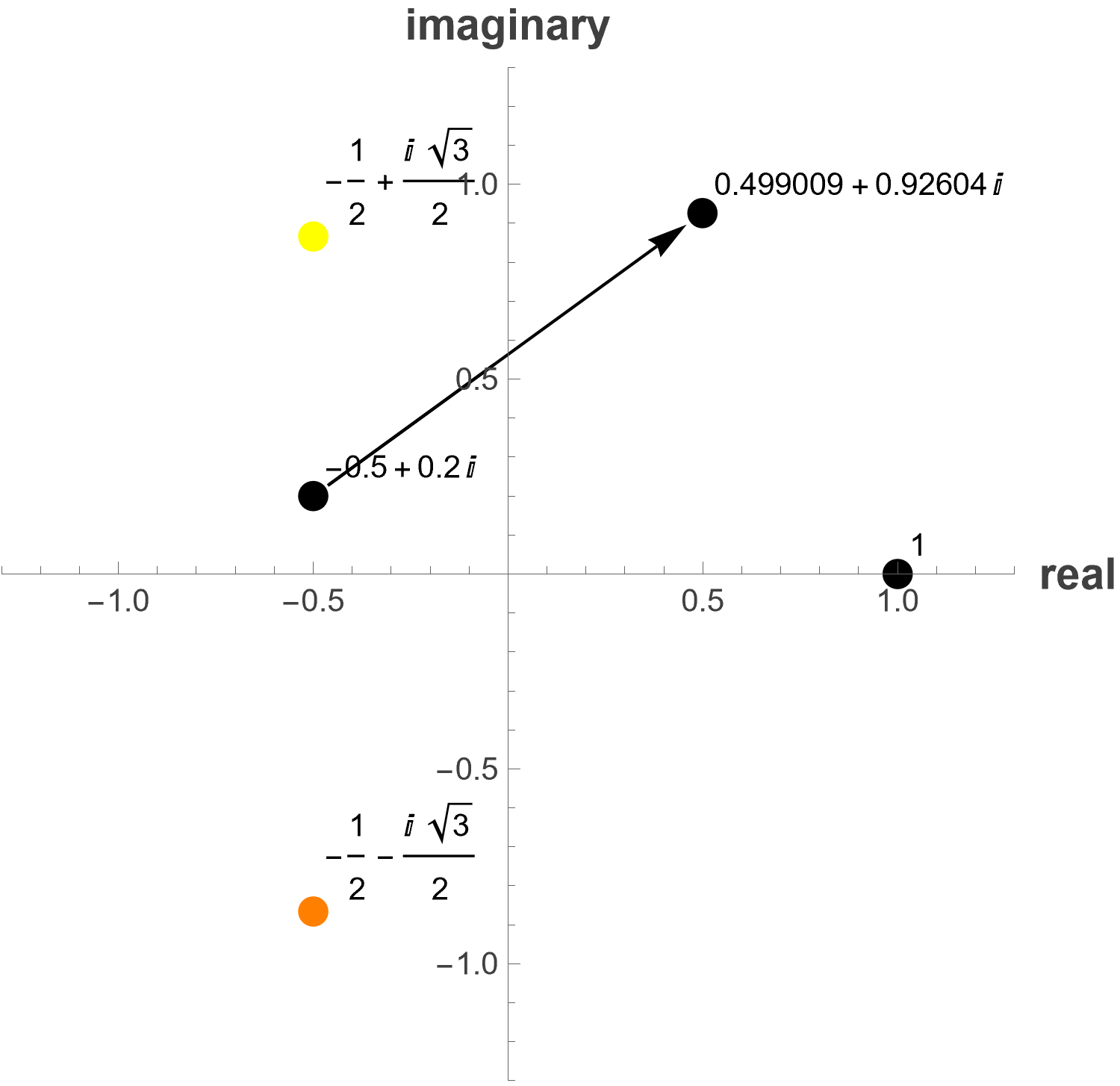
The step takes us to 0.499+0.926i. This doesn’t look like an improvement. If you were hoping it would simply move towards the closest cube root, you are now disappointed. But let’s keep going. Here’s where we end up after two steps:
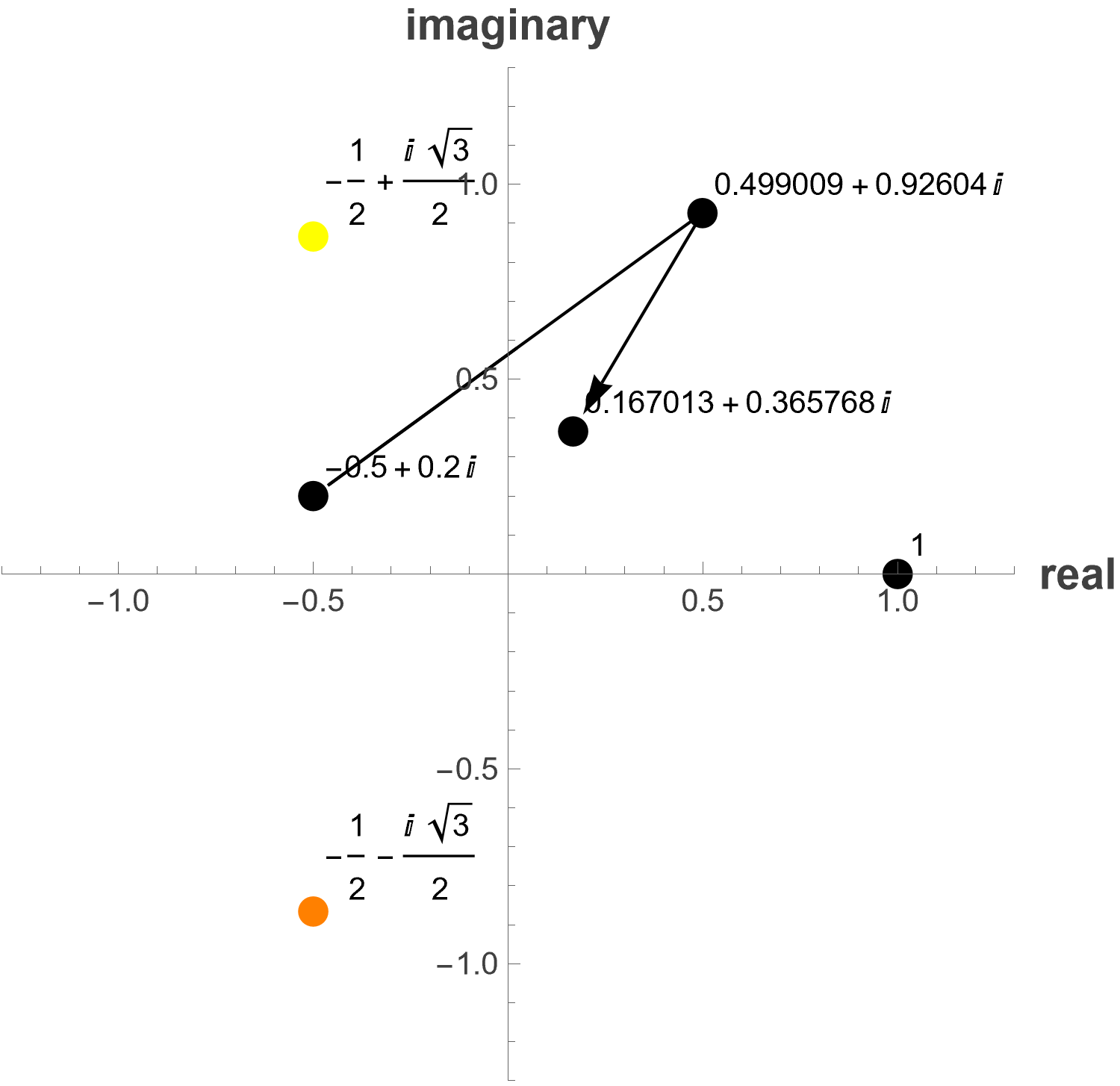
That doesn’t look promising. But let’s keep going.
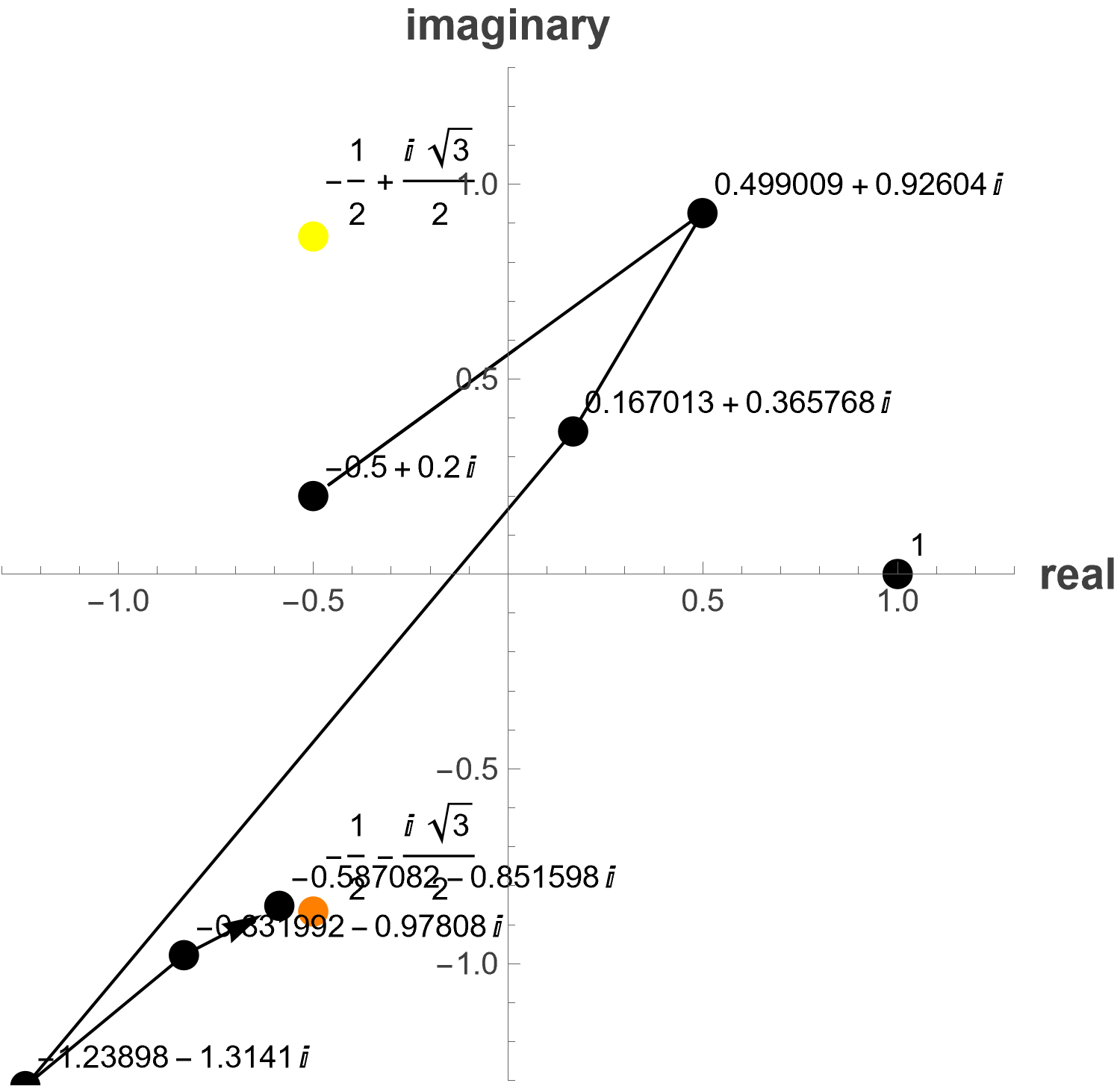
After 5 steps we are close to a cube root of 1. If we keep going, we just get closer to the orange root. The orange root is not the closest one to where we started. Since the root we ended up at is orange. I’m going to color all the initial guesses that lead there orange. Here’s the same figure again, but superimposed on the color graphic.
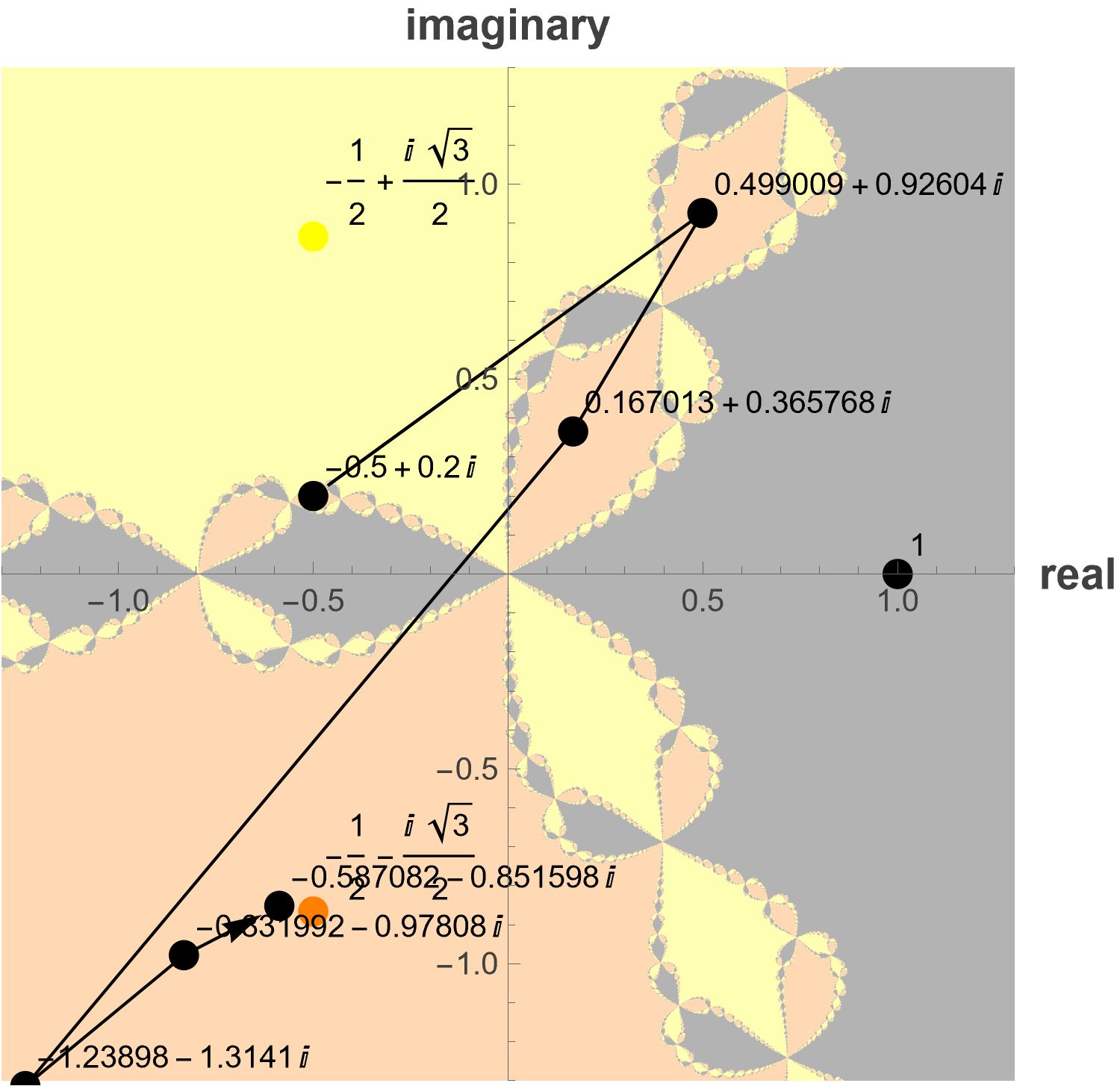
You will see that we started out in a small orange patch, and that all the steps are from orange to orange. I call this the “basin” of the orange cube root. If you think of Newton’s method as a system of rivers flowing over the complex plane, then the orange regions are all the places that eventually drain to the orange root. The yellow and black regions are the basins of the other cube roots.
It works for almost any initial guess—Newton’s Method will take you a cube root. (There are a few points on the complex plane for which Newton’s Method fails to find a cube root. When I say “almost any” I mean that the area of the set of all points for which Newton’s Method fails is zero.)
100 subscribers!
My substack has now reached 100 subscribers for the first time. Of course these milestones are meaningless. But on some of the other creator platforms I patronize it is customary to post some sort of reward for ones subscribers on reaching a milestone.
That’s a good thing!
This is your 100-subscriber reward. I confess that it looks more like something I like than something y’all might like. Therefore I’m asking advice. What would you like me to do if and when I reach 200 subscribers?
Answer in the comments, please!
To see that this works out, let’s try multiplying the second cube root by itself three times. First we’ll multiply it by itself.
(I used i²=-1 in the second-to-last step.) Thus z² is just the third cube root of 1. Finally,
So, yeah—it’s amazing, but it all works out.