
★★★★★ The Three-Body Problem, by Liu Cixin, Ken Liu (translator)
This is one for the neophiles!

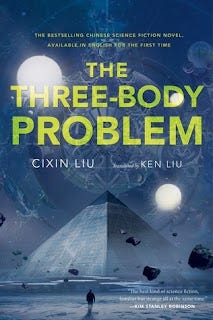
The Three-Body Problem
Liu Cixin, Ken Liu (translator)
** spoiler alert **
This is one for the neophiles!
This will be a review of all three books of Liu Cixin's Remembrance of Earth's Past, as translated into English by Ken Liu. HUGE spoilers for the entire series follow. You have been warned. Proceed at your own risk.
I bought The Three-Body Problem from Amazon 20-Aug-2015 -- I bought the next two books, The Dark Forest and Death's End on 10-Apr-2017. I think that means that The Three-Body Problem sat on my kindle for two years before I got around to reading it, and that in 2017 when I did I immediately moved on to the two remaining books.
The Three-Body Problem felt familiar, then the opposite of that. It was Golden Age Science Fiction. Now, "Golden Age" is a term of art in science fiction. It refers to that époque (early twentieth century) when science fiction was dominated by the pulp magazines, which were dominated by John W. Campbell Jr.. This was when every serious student of literature dismissed science fiction as trash. And, to be honest, they were mostly right. It would be flattery to call the characters two-dimensional. Women were there mostly to serve as rewards for the heroes, who were almost all men -- often (totally unrealistic) scientists. Plots were cookie-cutter. There were no real aliens -- the so-called aliens were all cosmetically modified humans. And humans always defeated the aliens -- this was a particular hang-up of Campbell's -- Earth always had to win.
I am quite certain that Liu has read a lot of Golden Age science fiction. To one like me who has read embarrassing amounts of Golden Age SF, it was like slipping on a pair of comfortable old shoes. We have the one-dimensional scientist characters. (But, credit where due -- there are both men and women.) Now, the good news for me was that the story takes place in China during the Cultural Revolution. I have read a lot about the Cultural Revolution, mostly nonfiction. But this was the first novel I had ever read in that setting, and I learned a lot.
And then Liu took it to new places. We have aliens who are *really* alien. Liu's universe is irreducibly hostile and more dangerous than a Mongol invasion. Aliens build extraordinarily dangerous weapons that destroy your solar system by folding space. I loved Liu's scientific imagination -- protons that contain artificial intelligences! (Is this possible according to our current physics? OF COURSE not. Duh. You have to imagine that lurking in the corners of fundamental physics that haven't yet been worked out -- that would be quantum gravity, mainly -- are some extraordinary engineering opportunities. Do I believe that this is probable? Absolutely not! But have you read science fiction? Liu comes much closer to making sense than most SF authors do.)
And then we have Liu's vision of the universe. If the aliens find out you exist, they will unexist you as quickly as they can, because they know that if they don't do unto you, you may eventually do unto them. They know this by experience -- only the biggest, baddest civilizations survive. I thought as I neared the end of Death's End that some humans were going to escape. But no. The aliens know what they're doing. Death's End ends with all Earth-derived life eliminated.
You may be wondering, from this description, why I give the series that five-star rating? I have said almost nothing in praise of the books. But here's the thing -- they're DIFFERENT, hugely different from anything I had read before and after. To a neophile like me, it was catnip.