
★★★☆☆ Paul Bunyan, by Esther Shephard, Rockwell Kent (illustrator)
True American Folklore

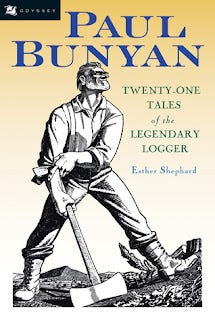
Paul Bunyan
Esther Shephard, Rockwell Kent (illustrator)
True American Folklore
I was reminded of Paul Bunyan by Nghi Vo's Into the Riverlands. Into the Riverlands is a Wuxia-style story of a trip through The Riverlands. The exaggeration of the character abilities reminded me of Paul Bunyan. (See my review here.)
I think I was 7-8 years old when I read Paul Bunyan, and after reading Into the Riverlands I decided that it might be time for a re-read. Of course, I see a lot in the book now that I didn't when I was a kid. For instance, I remember being surprised that these stories, which are almost entirely about men, were written by a woman. I did not at that age appreciate the distinction between "written by" and "collected by". Shephard is in fact quite careful to say in her Introduction and Acknowledgments that she collected the stories from lumberjacks and wrote them down just as she heard them. (That said, the book and illustrations by Rockwell Kent are obviously pitched at children -- one has to guess that involved considerable censorship by Shephard. She makes it clear, in fact, that these are a small subset of the hundreds of stories she had heard.)
I was pleased to see how imaginative the tall tales are. They go far beyond anything in Into the Riverlands. For instance, there is a story about how Paul tried to get rid of mosquitoes by introducing bumblebees to eat them. But the bumblebees and the mosquitoes bred to produce horrific huge flying insects with stingers at each end. There's another story about how Paul had a sawmill built in the East, then taken apart and shipped out west, where he hired an English engineer to reassemble the mill. The Englishman assembled the components back to front, and the result was a sawmill that worked in reverse-- if you fed sawdust in at one end, logs came out the other.
The Amazon page for the book quotes a review from The Independent saying, "This is authentic folklore, probably the one well-rounded folk tale America has developed . . . Besides being good fun, [it] neatly caps the point that American humor is at bottom exaggeration." The Independent is an English newspaper, and every American reader will wearily recognize the typical English snootiness towards American culture. (As the sawmill story above shows, we Americans sometimes mirror this disdain in our own way.)
While the claim that "American humor is at bottom exaggeration" is ignorant nonsense, I thought to myself that there might be a germ of truth. Is it true that this tradition of tall tales is specifically American? It's an idea that feels true to me, yet I have a hard time assembling data to support it.
The Paul Bunyan stories arise from an American game of one-upsmanship in which story-tellers compete in telling ever bigger whoppers. One can find many examples of such competitions in American literature. For instance, there are examples in Mark Twain's Life on the Mississippi. And I remember occasionally engaging in it myself. For instance, I remember bantering with students in this vein. In my memory, it is only American students who engaged, while Chinese, Korean, and Japanese students looked on with expressions of horror on their faces. I don't know if those memories are accurate, and even if they are, they may not mean what I'd like them to mean. It is entirely possible that the Asian students simply expect a professor to have dignity and are appalled to see one telling blatantly absurd tales.
But then, I think of other examples of tall tales. Into the Riverlands is not in itself a convincing example of Chinese/Vietnamese tall tale-telling -- Nghi Vo grew up in Chicago. But we have the Baron Munchausen stories, which come from 18th century Germany. We have Pippi Longstocking from Sweden. We even have the Monty Python sketch "Four Yorkshiremen".
So, I don't know. Certainly tall tales are not a uniquely American phenomenon. There may, however, exist an American subculture of tall tale-telling with its own distinctive character.