

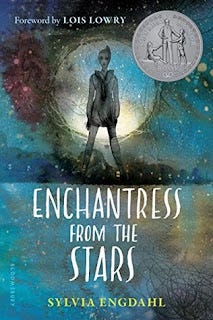
Enchantress from the Stars
Sylvia Engdahl
** spoiler alert **
The Hierarchy problem
Here is Enchantress from the Stars as I see it. Probably the way I see it is not the way you see it, and I am absolutely certain it is not the way that Sylvia Engdahl sees it:
Enchantress from the Stars recounts an encounter among three civilizations: The Andrecians, the Imperialists, and the Federation. The Federation is a culturally advanced interstellar Trekoid thingy, and is represented in this book by three members of the Federation Anthropological Service, Elana (the main narrator), Elana's fiancé Evrek, and her father. The Imperialists are from a planet that recently developed starships and that has landed on Andrecia to colonize it. The Imperialist narrator is Jarel. The Andrecians are a primitive agricultural civilization on Andrecia. The Andrecian narrator is Georyk. If you don't like my use of the derogatory word "primitive", you're going to have a problem with Enchantress, because this is explicitly how the Imperialists view the Andrecians, and also how the Feds view both the Andrecians and the Imperialists, although they substitute the dripping with condescension word "Youngling". The Feds use this word for any civilization that don't have the psychic powers the Feds do.
The Fed team has landed in order to foil the Imperialist invasion. They can't directly intervene because they have sworn an oath that is basically the Prime Directive from Star Trek. (Engdahl even tells us in her FAQ that the Service Oath is meant to be an improved version of the Prime Directive.) So Elana's father has a sneaky plan to get the job done.
To understand the plan, you have to understand that Elana's father is a morally flexible puppet-master who has no scruples against tricking absolutely anyone, up to and including his own daughter, into doing what he has convinced himself is The Right Thing. His plan is to teach a naive Andrecian a magic trick (psychokinesis -- this is something the Feds can do), have him perform it in front of the Imperialists, thus scaring them off the planet. Does this sound like a believable plan to you? It doesn't to me. But on the other hand, if you're a character in a novel and the author is on your side, any plan is a good plan.
So they do it. Georyk gets to be the Andrecian patsy. Of course he and Elana fall in love, because that's just what happens in novels like this. What's more, Elana's father later admits that he manipulated them into falling in love, in order to better motivate poor Georyk. With a small assist from Jarel (remember Jarel?) the implausible plan is implausibly a Complete Success.
Enchantress from the Stars on Amazon
Goodreads review
This novel also trips over one of my pet peeves. I'm going to bore y'all by ranting about it, but I'm protecting it with spoiler tags so you don't need to see it if you don't want to.
[spoiler1]
I have for many years been unhappy with the treatment of telepathy in Science Fiction. The authors of SF novels never seem to realize that telepathy is real, we have it, and the real thing is a far richer and more interesting phenomenon than the pale imitations they invent. Here’s how it works: each of us (well, most of us) has an organ in our head, controlled by the brain, that can transmit waves through the air. These waves encode thoughts. We also have two organs in the head (two for directionality) that can sense these waves and sent them to the brain. There are specific parts of the brain devoted to encoding and decoding thoughts. In this way I can transmit my thoughts to you.
Now, some of you are saying, “Does L really believe this? What are they smoking?”. But the others got the con. Here is that explanation again, with gloss:
Each of us (well, most of us) has an organ in our head (the mouth), controlled by the brain, that can transmit waves (sound waves) through the air. These waves encode thoughts (the encoding is called “language”). We also have two organs (ears) in the head (two for directionality) that can sense these waves and sent them to the brain. There are specific parts of the brain (Broca’s and Wernicke’s areas, mostly) devoted to encoding and decoding thoughts. In this way I can transmit my thoughts to you.
Telepathy is such a fantastically useful thing that it would be astonishing if we did not have it. So, in fact, we do. Now I’m obviously cheating here -- speech is not telepathy. Why not? Because the definition of telepathy specifically excludes it: “the communication of thoughts or ideas by means other than the known senses”. In other words, telepathy is, by definition, speech without speech. But in every important functional sense, we humans are telepathic. In fact, you and I are engaging in an act of telepathy right now.
Now, most SF authors who put telepathy in their books realize that they have to make it better than speech somehow, or what would be the point? What really bothers me about these attempts to pump up telepathy is that they are so, so lame. Speech and language are such amazing, fascinatingly versatile parts of human culture, encompassing not just in person vocal communication, but writing, music, ASL, poetry, sound recording technology... No fictional version of telepathy I have ever seen comes even close to the real thing.