
Quite Contrary
Mary, Mary quite contrary, How'd you get your eyes so scary?—“Quite Contrary”, Parker Milsap

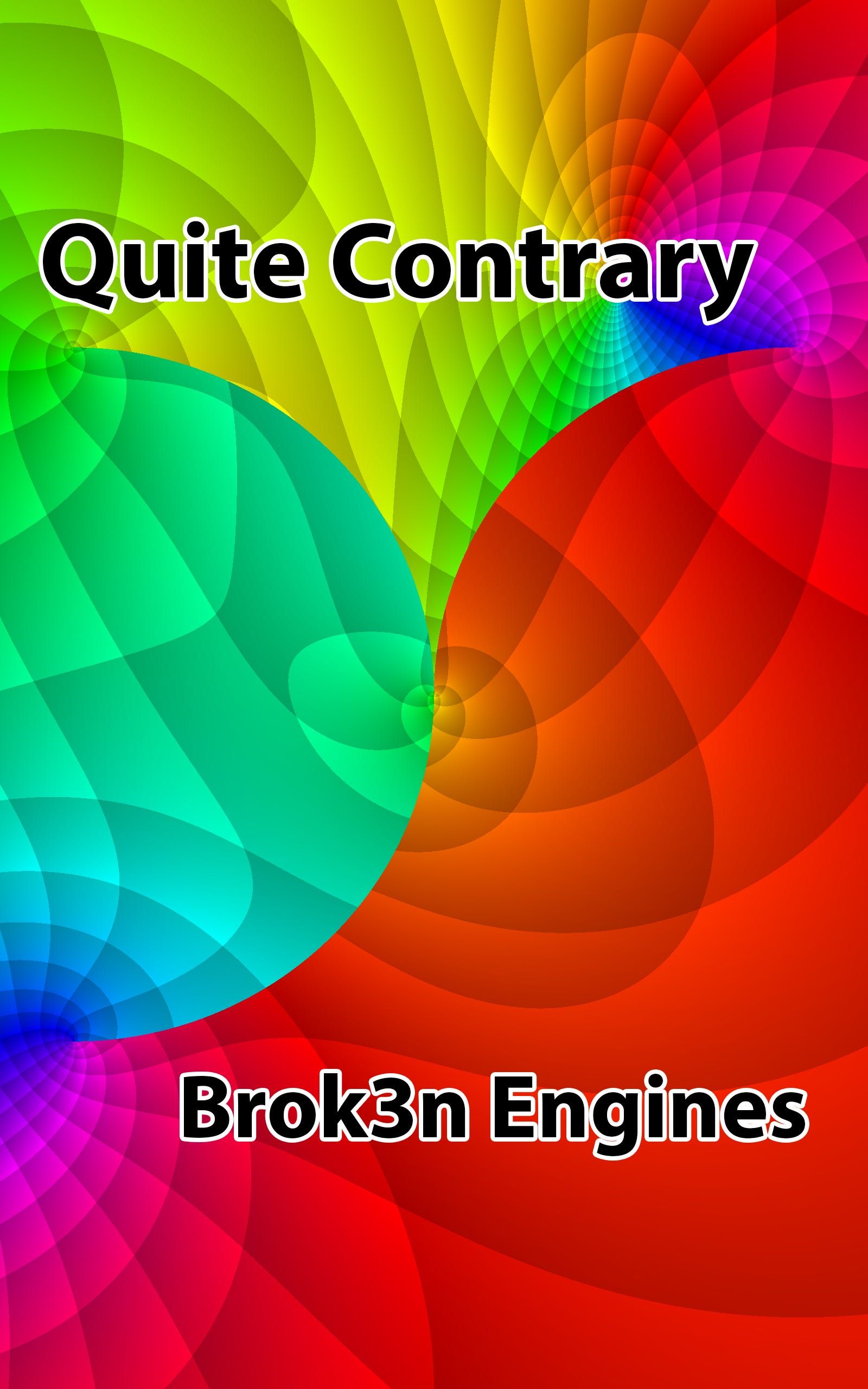
Quite Contrary
Mary, Mary quite contrary
How'd you get your eyes so scary?
—“Quite Contrary”, Parker Milsap
Jack Horner met Mary Lennox at the entrance of the National Eye Institute.
Horner was a small, intense man with dark eyes. His movements were erratic and unpredictable, as was his speech. “Mary Lennox, herself! They say you know how brains work.”
Lennox was a self-contained woman of about thirty with conservatively cut blond hair. She answered, “No one knows how brains work.”
“That’s what I said. But maybe a little?”
“Maybe a little,” she smiled.
“And what does Mary Lennox have to say to Jack Horner?”
“I’m interested in cortical visual prostheses.”
“Good! Good! Maybe you could make them work.”
“Don’t they work now?”
“Just barely. Nowhere near the real thing.”
“I might be able to help. I’m highly motivated, Dr Horner.”
“Jack, please! Motivated, how?”
“I’m going blind. I have retinitis pigmentosa.”
“Aha! What do you know about CVPs?”
“Well, of course I’ve read up on them since my diagnosis.”
“Here’s why they don’t work. One: too coarse. A few hundred points at most.”
“I’ve read that normal vision is 576 megapixels.”
“Of course. I even know where you read it. It’s bullshit! Far too precise a number! Besides, we don’t really see that way. No one knows that better than Mary Lennox, I bet.”
“You said ‘One.’ There’s a “Two”?”
“Two: we don’t know how the brain sees. Even if you had 576 million electrodes in your visual cortex, we wouldn’t know what to do with them. For that we need you.”
“You keep saying things like ‘we need you.’ It makes me think you imagine that CVPs can be improved.”
“You got me! I think I can solve problem One, if you can help me solve problem Two.”
“You’ve developed a 576 megapixel implant?”
“Better than that! Millions of microscopic nanites in your brain. Individually addressable, powered and controlled wirelessly.”
“And then what?”
“Well, to be honest, right now it’s an Underpants Gnomes business plan1. I have a technical description of the nanites. Read this tonight, and then let’s talk again.”
#
Alone in her hotel room, the light of a glowing laptop on her face, Mary thought, “This is brilliant! Fucking brilliant! It could work.”
#
“I’m impressed, Jack.”
“Like you, Mary, I’m highly motivated.”
He answered the question in her eyes with one word, “Epilepsy.”
“Medication doesn’t help?”
“Not looking for a cure. You know that seizures can bring visions?”
“I’d not heard that.”
“But I’ll bet you know that seizures can cause, ‘hallucinations’ and “cognitive symptoms.’”
“Oh, yeah. I did know that. But I never put it together like that. What sort of visions do you get?”
“Well, you read one of them last night.”
“Ah! Your nanites?”
“I’m a pretty good engineer, better than 999 in a thousand. When I take my seizure medication, that is.”
“And if you don’t?”
“That’s when I see visions. Then I’m not one in a thousand, but the one person on Earth who can do what I do.”
“So, you don’t take seizure medication?”
“I do. Seizures are dangerous. Most of the time I’m what you see now—just another weirdo,” he grinned at her.
She grinned back in Weirdo. “But some of the time?”
“Sometimes I know that a vision wants to be, and I’ll go off my meds to give it a chance.”
“You’re a shaman who can put himself in an ecstatic state and have visions of the future?”
“Or something.”
#
“Jack, have you built these nanites? Or is that paper you gave me vaporware?”
“We made them. We even put them in a brain, and they work.”
“A brain?”
“This one,” said Jack, tapping his forehead. “Come with me.”
Mary followed Jack to a laboratory. He sat down in front of a computer, then put something that looked like a lightweight helmet on his head.
“I call it a helm,” he said.
He opened an application on the computer and typed a number into a search field. A new window opened up that showed a scrolling graph. The graph spiked erratically, every few seconds, accompanied by a click.
“That’s a neuron in my brain. Each time it fires you hear a click.”
“Where in your brain is it?”
“See if you can guess!” He clicked a button and a new window opened up, a white square with a black dot in its center . He touched a key, and a black bar appeared in the window. He then fixed his gaze on the black dot. With his hand, he began to manipulate a gaming joystick. The black bar twisted to different angles and swept across the window as he worked the joystick. When it traversed one particular part of the window, the clicking turned frantic, then died away.
“Aha!” said Mary. “Is that a simple cell in primary visual cortex?”
“We think so.”
“You think?” Mary said. “You don’t know where the nanite is?”
“No,” Jack answered. “This would all be much easier if the nanites told us where they were.”
“Well, why don’t they?”
“Not as easy as it sounds. The microwaves we use to communicate with them have wavelengths of two or three centimeters. We can’t locate them more precisely than that. That particular nanite is in my left occipital lobe.”
“So it could be primary visual cortex!”
“Yup!”
“Question, can the nanites talk to each other directly? I mean, without communicating through that very fetching cap you’re wearing?”
“In a way. If two nanites are close to each other, they interfere. They’re not really talking to each other—it’s something we know about because it’s a problem we need to avoid.”
“Ah, Jack! Don’t you see? This could solve your mapping problem. If you know for every one of several thousand or million nanites exactly which other nanites it is close to, you can reconstruct a three-D map of their locations.”
“You and I will make beautiful machines together!”
#
They did.
Working with the nanites in Jack’s brain, Mary solved the mapping problem. When she was finished, they knew the locations of 11,483,256 nanites scattered throughout Jack’s brain. That wasn’t all of them, but it was most of them. Mary could also use the ones in Jack’s primary visual cortex to show him crude images from her computer.
Together they improved the design of the nanites. They would inject the new version into Mary’s brain. It was ever more urgent. She could still see, but she had tunnel vision. Soon she would be completely blind.
They did it. They put 50 million of their most advanced nanites in Mary’s brain.
And then she started to work. Later, they called it “Mary’s Madness.” She was a coder, and she knew what it is like to sink her awareness so deep into the code that it felt as if there was no longer any distinction between her and the machine. Now it was literally true. The machine was her—she the machine.
Only Jack dared approach her when she was in flow—she would bite your head off for interrupting her. He was her only real companion in this work. Only Jack could understand what she was accomplishing. More important, he sympathized with her elation at her breakthroughs. Only he could persuade her to step away from her computer to eat and sleep.
Her eyes had long ceased to function when she finished. She no longer used a keyboard or a monitor. She controlled the computer with her thoughts and projected the output directly into her brain.
For fun, they built a telepathic link. Jack would plug an ethernet cable into his helm, and Mary would plug the other end into hers. Then her thoughts were sent to his auditory cortex and his to hers. They could hear each other think.
#
Finally, the day came when Jack said, “Mary, it’s time we gave you eyes. Let’s start you out with the eyeglass camera we use with CVPs.”
This was a simple black and white camera mounted on a eyeglass frame. Mary mastered it in a day or two. She was no longer blind, but her vision was limited, She was not satisfied.
“I want more. Together we can build something that will let me see better than you, or any person with normal sight.”
Jack’s next creation used two high resolution webcams for the eyes, gimbal-mounted so that Mary could swivel them like real eyeballs in their sockets. With macro zoom lenses, it was like having telescopes or magnifiers for eyes. Because of their size, Jack mounted them on a bigger helm.
Mary with her helm and her wide-set camera eyes swiveling and zooming was a disconcerting sight. Jack’s nephews pronounced it “shit wicked,” which she understood from their enthusiasm to be a Good Thing. They called her “Mary Scary Eyes.” Jack looked severe, but Mary laughed. People around the Eye Institute soon grew used to Mary Scary Eyes.
#
As Jack came in one morning reception told him, “There’s a man from the Pentagon here to see you and Dr Lennox.”
He wasn’t obviously military. He looked to be in his thirties, handsome in an unremarkable way, and wore a business suit. Jack and Mary met him in Jack’s office. He introduced himself as “Burnside.”
“Like the Civil War general?” Mary said.
“Just like that,” Burnside responded.
“You’re from the Pentagon?” Jack asked.
“Intelligence,” Burnside said.
“Which service?” Jack asked.
“I’ve been reading your progress reports.”
“Helps you sleep?”
“To be quite honest, I think they’re gripping. Do you know what you’ve invented?”
“We think so,” Jack said.
“Cyberspace!” said Burnside.
“Huh?” responded Jack intelligently.
“I think Dr Lennox recognizes the word,” said Burnside.
“It’s an idea from science fiction,” she confirmed.
Burnside continued, “In the 1980s William Gibson wrote a series of novels in which computer users interacted in what he called ‘Cyberspace. A consensual hallucination…’ Later the term was adopted by Internet users, who of course experience the network through screens and speakers and earphones—that is, through two of the ordinary senses that most of us share.”
“But…” Jack prompted.
“That was not Gibson’s vision. He imagined that the images and sounds of cyberspace were sent directly into brains. He even imagined an entertainment medium called sim-stim in which entertainment was sent directly into brains. The user just put on a lightweight electrode headset. And Gibson wasn’t alone. Hundreds of science fiction writers have assumed the same technology.”
“Science fiction writers have the luxury of using any implausible technology they can imagine,” said Mary. “It’s no end annoying.”
Burnside said, “I don’t need to tell you two that sim-stim is not easy, and that you can’t make it work just by putting on a lightweight electrode headset. But you have built it!”
“Now, hold on a minute,” Jack burst out. “You’ve read our reports, so you know that putting our nanites in a brain requires surgery. Brain surgery! Making holes in people’s skulls! It would be dumb to go through that just to improve your experience of Buffy the Vampire Slayer!”
“Dr Horner, do you know that an F-35 stealth fighter jet costs a hundred million dollars?”
“I guess I do now.”
“The men who fly those fighters risk their lives on every mission. I have no doubt they’d be willing to undergo brain surgery to become the jet.”
Mary was hard to read with the helm covering the upper half of her face. In fact, Jack thought Mary could be the world’s best poker player, with that unreadable face, eyes able to capture every nuance of other players’ body language, and the hardware to calculate a game-theory-optimal betting strategy in seconds. Burnside probably couldn’t tell, but Jack could see that the vision of becoming the jet had caught Mary.
“Let’s talk privately about this,” Jack said.
#
“Talk privately” was a code phrase of theirs. After Burnside left, Jack donned his helm and connected the cable to hers.
Do you really think they’re eavesdropping on us, Jack?
Burnside is intelligence. If he wanted to bug us, he could. And without us knowing! How secure is this link, Mary?
I would say completely. I used the usual Secure Socket Layer library for the traffic on the wire, so it’s encrypted. But even if they could break that, it’s just commands to numbered nanites in our brains. Without our brains, the signal on the wire is meaningless. But, Jack, I don’t get why you’re worried about secrecy.
Well, Mary, think about this. We build them a system that a pilot can use to become a Stealth Fighter. Then what? Even I know that weapon systems are classified.
I don’t like where you’re going with this.
Gets worse. They won’t just classify the jet control system. I bet you whatever you want, they’ll take the whole ball of wax. No one outside the military gets to use my nanites! Nanite vision for retinitis pigmentosa patients not named Mary Lennox? Nope. National security requires that the military keep this treat for themselves.
Fuck, fuck, fuck! You’re right! Once you have the nanites and the mapping, it’s too obvious that you can control weapons with it. Why didn’t I see that?
I think I know.
You’ve been reading my mind?
Well, yeah, Mary, it’s not that hard. We’ve worked together for a while now. I don’t think that Burnside could see it, but to me it looked like you were interested. Like, really interested. Like you were thinking that you would be super jazzed to be a fighter jet?
Well, yeah. Wouldn’t you?
Not like you. You’re more hands-on.
And you’re not sold on the idea, right? You were hostile to Burnside, almost petulant.
Well, yeah. Isn’t it obvious? We built it to help people like you see. I never set out to build weapons.
Jack, you’re a man who has visions of beautiful and powerful machines. You built this one because you wanted to understand your visions better.
Did I tell you that?
Actually, Jack, you kind of did. When we first met, you said you were motivated by your epilepsy.
I said that?
You did. It’s true, isn’t it?
Yeah…
That could only mean one thing. You thought that the nanites would help you understand your seizures. And I know you, Jack: you don’t want to lose your visions.
You’re scary smart, Mary Lennox.
I’m flattered, I think. Am I flattered, Jack?
Definitely. What’s your point?
Well, see, I know you don’t like Burnside, but he’s no fool. He says we invented cyberspace. He’s right. Not sim-stim, though—you’re right, no one’s getting brain surgery to improve their TV viewing experience.
I hear a ‘but’ coming.
Letting the blind see is a Big Thing! I was glad to let a brain surgeon in to make me see again, and I wasn’t the first.
And jets?
Not as big. Burnside is right, though. Bringing sight to the blind is not the only Big Thing we can do. Fighter jets are big enough to make brain surgery worthwhile. Fixing epilepsy may be another, and there are so many, many more.”
Like what?
Jack, to tell you the honest truth. I am not scornful of the jets. I would love to become a jet. I can’t think of a cooler ride. I would love to become an electron microscope. I would love to become the Space Telescope for an hour. I would love to become LIGO and watch black holes collide. Think of robot-assisted surgery. And Jack, more than anything I would love to watch a living brain in action.
#
Burnside checked the logs. The two of them had stayed in Horner’s office for almost an hour after he left. But the audio from the office recorded nothing. There was no sound from Jack’s “Let’s talk privately about this” until they left his office 48 minutes later.
Burnside dismissed what some of his colleagues would have called the obvious answer. True, they were healthy adults in their thirties and had worked closely together for months. But he didn’t read them as having that kind of relationship. Even if they did, they were unlikely to indulge it in an office liaison. And to do it without the mic picking up a sound! How he wished he had had a camera in there, so he could see what they actually had been doing.
Burnside concluded that they had somehow done exactly what Horner had suggested: talked privately about his proposal. Somehow they had done it without making a sound. They were downy birds, Horner and Lennox.
#
“We’d like to show you something, Burnside.”
Mary, as usual was wearing the helm that gave her vision. Jack put on his lighter helm, and connected it to Mary’s with a cable.
Jack handed Burnside an index card. “Write something on this card. Show it to me, but not to Mary.”
Burnside did as instructed.
Mary laughed, and said, “‘For now we see through a glass darkly, but then face to face.’ Very a propos, Burnside.”
Burnside said, “So that wire allows you, Mary, to see through Jack’s eyes?”
“No, but it allows him to speak his thoughts to me when he chooses. I didn’t see your card—Jack read it to me.”
“Wired telepathy! But wouldn’t it be more useful if you could do it over a network?”
“You’re right. This was just a quick fun hack when I was figuring out how to make nanites work.”
“So what is it good for. Privacy?”
“Yes, that. But more important than privacy is trust. You can’t lie over this wire.”
At Burnside’s quizzical look, Jack said, “You can lie, but you can’t deceive. If you lie, the other guy knows you’re lying. If the other guy is Mary, she knows more than that.”
“Why is that? Is there a back door, Dr Lennox?”
“No, Burnside. There is no back door. Everyone on the wire has the same information. What Jack means is that, because I created the system. I know exactly what information it gathers and transmits, and how to interpret it. And at this moment, no one on Earth knows more about how a brain works than I do.”
“You’re showing me this, why?”
“Burnside, this project is a very big deal for Jack and me. It’s the most important thing we’ve ever done, or will ever do. And the honest truth, Burnside, is that Jack and I have difficulty trusting you and your bosses completely.”
Burnside’s eyes opened wide in an innocent look, and he spread his hands.
Jack said, “Hey, man. Spare us the innocent act. You’re a spy.”
“Well, yeah, and you two are no fools. You obviously have something in mind.”
“Yes. We want all discussions on use and development of nanites to be done by wired telepathy, of the type we just demonstrated for you,” Mary said.
“But how? You’re the only two people equipped to talk this way—Oh! I see.”
“Yes, we’re offering to implant nanites in the brain of a liaison from your organization. Anyone you designate. You, Burnside, seem the obvious choice, if you’re willing.”
Burnside paled. “I wasn’t expecting that!”
“This is the surgery you propose for each of your fighter pilots. It’s not trivial, by any means, but hundreds of visually impaired patients have received cortical visual prostheses. Of course the surgeons would need to evaluate you, but it’s typically relatively safe for a healthy man like you.”
“It’s not the surgery that scares me. It’s opening my mind to you two.”
“The link doesn’t work that way. Communication is a conscious choice. The other party on the wire hears only the words you choose to send. Your private thoughts are no more exposed than they are right now, having an in person conversation.”
“How do I know that you will not read my private thoughts and feelings, or even influence them?”
Jack answered, “Honestly, you don’t. You’d have to trust us.”
Burnside looked even more alarmed. “I’ll need to talk to my bosses about this.”
You know, Jack, I think I could actually do that—read his mind, and maybe influence his decisions. I don’t have the tools now, but with a little development…
That would be unethical, Mary!
You’re right. Forget I mentioned it.
#
Burnside did it. A couple months later, when he had fully recovered from surgery and his nanites had been mapped, he met Mary and Jack in Jack’s office, and donned a helm. Mary connected her helm to Jack’s and Burnside’s.
Do you hear this? Burnside heard in Jack’s voice, but not through his ears.
“I do! Wow, that is weird.” Burnside said.
Try that again, but without speaking aloud.
Like this? thought Burnside.
Like that, Mary confirmed. Now, I want you to lie. Think something at us that you don’t believe.
Burnside responded, Horner is an unimaginative hack, and Lennox is not very smart.
They all laughed, not so much at the words, as at Burnside’s obvious incredulity at his own thoughts.
See, now? That’s what a lie feels like.
Jack thought, Burnside, Mary and I have a few worries. To start with, this: you have mentioned your “bosses” once or twice. Who’s is charge? Are you in position to make decisions?
Not really. I’m one member of a committee of about 30. We require a majority vote for any decision, two thirds for a major decision. This would be a major decision.
Everyone, Burnside included, felt a note of falseness in this answer.
Let me try that again, he thought. Every word of what I just told you is true. But everyone knows this project is my baby.
So? Jack prodded.
So, I think if you can persuade me, I can sell it to the committee. Also, getting this done—Burnside gestured vaguely at his helm—has bumped my cred. I’m seen as having taken one for the team. And paradoxically, some of the members are a little jealous. They’re excited about the potential of telepathy for high-trust negotiation.
Of course, he continued, if you ever tell anyone what I just told you, I will deny it, and I will denounce you both as lying liars who lie.
Fair enough! said Jack.
Mary thought, And you bring up our second point: civilian applications. We built this system so that blind people like me could see. High trust negotiations are another application. Will the military shut us down by classifying our work?
Any system for controlling fighter jets in combat is going to be classified at the highest levels.
Of course, we understand that. But will Jack’s nanites and my mapping and reading algorithms be classified?
Jack added, It’s a red line for us, Burnside. We don’t help unless you convince us you won’t shut down civilian applications.
If you can’t do that for us, Burnside, you’re on your own, said Mary. We know you’ve got your own scientists and engineers. But if you classify the work we’ve already done in such a way that civilian applications become impossible, you get no help from us.
Burnside was taken aback. He hadn’t foreseen this, but he felt Jack and Mary’s resolve.
If this method of communication does nothing else, it tells me how strongly you feel. What kind of guarantees would you accept?
Tell us through this link that you believe… thought Jack.
Yes, Burnside. Convince yourself, then convince us that you’re convinced.
I’ll have to talk to the committee about this. We would certainly need to negotiate fine points—the precise boundaries of what can be made public. I’ll get back to you.
And Burnside, one last thing, thought Jack.
Yes?
Are you bugging us?
No comment, Burnside responded. He unplugged his cable and left.
Well, Mary?
“He definitely is bugging us,” Mary answered aloud. “Burnside hears every word spoken in this office.”
#
In the end, Jack and Mary got almost everything they wanted. In fact, Jack felt almost as if Burnside had joined their team. He was on their side, and wanted what they wanted.
He asked Mary one day, “Did you ? Push Burnside to give us the deal you wanted? Did you?”
“That would have been unethical,” she answered.
Afterword
The cover image is a phase portrait of

It represents components of the visual system. “lon” is left optic nerve, “ron,” right optic nerve, “lot,” left optic tract, “chiasm,” optic chiasm, “lvc,” left visual cortex, and “eye” is obvious.
A phase portrait is a visualization of a complex function introduced by Elias Wegert in Visual Complex Functions: An Introduction with Phase Portraits.
Musical Inspiration
The Underpants Gnomes (from the television series South Park) business plan is:
1. Collect underpants
2. ?
3. Profit